
A hall tree is a piece of furniture that combines a coat rack, a storage bench, and often shelving or cubbies into a single unit for an entryway. You need one when your home lacks a designated area to transition from the outdoors, specifically when you need to manage multiple coats, bags, and shoes simultaneously. You should measure your available wall width and the depth of your narrowest door to ensure the unit fits without obstructing the path. Most residential entryways benefit from a unit with a depth between 12 and 18 inches to maintain clear walking space.
How a hall tree prevents entryway clutter and floor pile-ups
Entryway clutter creates a bottleneck where items like wet umbrellas, heavy jackets, and muddy boots accumulate on the floor or chairs. This lack of organization often leads to items being misplaced or damaged by moisture. A hall tree solves this by providing a vertical storage solution that lifts items off the ground and organizes them by type. By consolidating these functions into one footprint, it prevents the “pile-up” effect that occurs when a household lacks a dedicated mudroom or foyer.
You can view our guide on picking the best farmhouse hall tree with bench to find a rustic seating option.
How a Hall Tree Functions in an Entryway
A hall tree functions by organizing items through a sequence of physical actions that move belongings from a state of transition to a state of storage.
If you prefer a contemporary aesthetic, see our top picks for the best modern farmhouse hall tree.
- The user places heavy outerwear on the hooks, which distribute the weight across the frame to keep the items off the floor.
- The user sits on the integrated bench to remove shoes or boots, utilizing the seating area as a stable platform for tasks that require balance.
- The user places footwear into the base cubbies, which keep the items contained and separated from the walking path.
- The user places bags or smaller items on the shelves or hooks, utilizing the vertical height of the unit to maximize the storage capacity of the wall space.
Hall Trees we have reviewed in detail
Prices across these 3 run from $219.99 to $249.99; each one has a full review here.
To keep your foyer tidy, explore the best hall tree for organized entryway solutions.


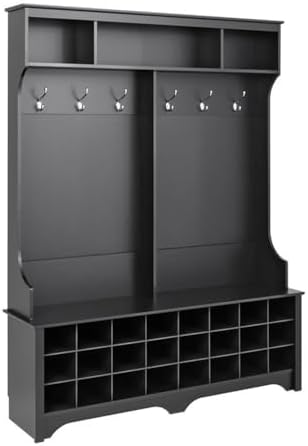
Parts of a Hall Tree That Matter to Buyers
The design of a hall tree relies on specific components that dictate how much weight it can hold and how many items it can organize.
Why 4 to 6 inches of hook clearance prevents coat overlap
Hook spacing determines how many coats or bags can be hung simultaneously. If hooks are placed too close together, bulky winter parkas will overlap, preventing you from hanging more than one or two items. For a household with multiple people, look for a layout that provides at least 4 to 6 inches of clearance between the center points of each hook.
For those prioritizing footwear storage, see our comparison of the best hall tree with shoe cubbies.
Checking cubby internal clearance for proper boot fit
Cubby dimensions ensure shoes or boots fit without overlapping. If the interior width of a cubby is narrower than the widest part of a boot, the item will protrude into the hallway. You must check the internal clearance of the bottom storage area to ensure it accommodates the specific size of the footwear you use most often.
If you need a place to sit while putting on boots, look at our selection of the best hall tree with storage bench.
Bench weight capacity and wall mounting for user safety
Bench weight capacity determines the safety limit for sitting. Because the bench is often the heaviest part of the unit, it must be able to support the weight of an adult while they are leaning forward to remove shoes. A stable bench requires a wide base or a wall-mounting kit to prevent the unit from tipping forward during use.
Proper spacing is vital, so learn how to choose the correct depth for hall trees.
What Having a Hall Tree Changes in Practice
Having a hall tree changes the flow of a home by creating a “landing zone” where belongings have a permanent home the moment you enter. In a small apartment, it replaces the need for a separate chair and a standalone coat rack, saving approximately 4 to 6 square feet of floor space. It ensures that wet coats do not drip onto carpeted areas because the hooks keep the fabric suspended.
How a hall tree improves morning routines versus closet storage
The difference shows up most clearly during morning routines where you can grab your gear without searching through a closet. However, the difference does not show up in the amount of storage provided for items like umbrellas or groceries, which still require separate solutions. A hall tree is a tool for organization, not a substitute for a full-sized closet or a large mudroom.
Make sure the unit fits your ceiling by learning how to choose the right height for hall trees.
Common Questions About Hall Trees
How does the quality of the engineered wood compare to solid wood options?
Engineered wood provides a stable, flat surface for the bench and shelves because it is less prone to warping than solid wood in humid entryways. It is generally more affordable and allows for consistent cubby dimensions across the entire unit. Solid wood offers higher durability for the hooks and frame but may expand or contract, which can cause the storage cubbies to stick or shift over time.
To ensure it fits your wall, see how to choose the right width for hall trees.
How does the weight capacity compare to other metal hall trees?
Wood and engineered wood hall trees typically have a higher weight capacity for the bench because the material has a higher load-bearing surface area. Metal hall trees often rely on a narrower vertical pole, which limits the amount of weight that can be hung on a single point without bending. If you have heavy, wet winter coats, a wider wooden frame provides a more stable distribution of weight than a thin metal rod.
Different styles serve different needs, so view the different types of hall trees explained.
Does the backer board make it sturdy enough to stand without tipping?
A backer board provides lateral stability by connecting the side panels and the hooks to a single rear plane. This prevents the unit from swaying side-to-side when you pull a heavy coat off a hook. While a backer board improves stability, it does not replace the need for a wide base or wall anchoring if the unit is tall and narrow.
Is this better than a standard open rack for a small space?
A hall tree is more efficient than a standard open rack because it combines three functions into one footprint. While an open rack only holds coats, the hall tree adds the bench and cubby storage. This consolidation allows you to clear more floor space in a cramped hallway by stacking the utility of the furniture vertically.
For a slim profile, check out our full review of the Prepac Narrow Hall Tree.
How does the storage space compare to a standard mudroom bench?
A hall tree provides less total volume than a full mudroom bench because it lacks the deep, expansive seating and large storage bins of a dedicated mudroom unit. However, it offers more specialized hanging space for coats and hats. It serves as a high-density storage solution for the items you need to grab quickly, rather than a high-volume storage solution for items you keep for the season.
Coastal designs are also available, so see our full review of the Seaside Hall Tree.
Who Needs a Hall Tree and Who Does Not
You need a hall tree if you live in a home with a high volume of daily outerwear but lack a dedicated mudroom or foyer. It is a necessary choice for households with children who need a low-height bench to sit on while putting on shoes. If you live in a studio apartment where every square foot of floor space is critical, the consolidated design provides the most utility per inch of floor space.
For a sturdy shoe cabinet, see our full review of the SOG-0013-1 Hall Tree.
When a hall tree is unnecessary for large entryways
You do not need a hall tree if your entryway is large enough to accommodate a separate bench and a dedicated coat closet. If you rarely wear coats or own more than two pairs of shoes, a simple wall-mounted hook strip provides the same functionality without the footprint of a piece of furniture. A hall tree is a solution for transition management; if your transition happens in a walk-in closet, the hall tree is unnecessary.
The other hall tree guides we have published
Hevan is reader-supported: some links on this page are affiliate links, and as an Amazon Associate Hevan earns from qualifying purchases at no extra cost to you. Learn more.