
A hall tree is a piece of furniture that provides a central location for hanging coats, storing shoes, and providing a seating area in an entryway. You need to identify which features provide actual utility and which are marketing filler to ensure the unit fits your floor plan and your household’s daily needs. While many listings highlight aesthetic styles, the load-bearing specs are the physical dimensions, the material composition, and the weight limits for the bench.
You can find our top picks for selecting the best farmhouse hall tree with bench to suit your home style.
Hall Tree Storage and Capacity Terms
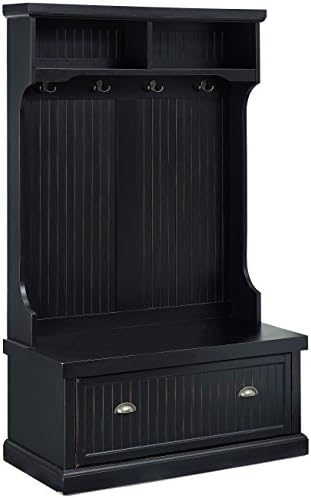
- Number of Hooks — This measures the total count of individual hanging points on the unit; 46 of the 69 listings we screened state this figure. A higher count allows you to hang more coats or bags simultaneously without overlapping.
- Hook spacing — This determines how much distance exists between each hook. Proper spacing ensures that bulky winter coats do not crowd out smaller items like hats or umbrellas.
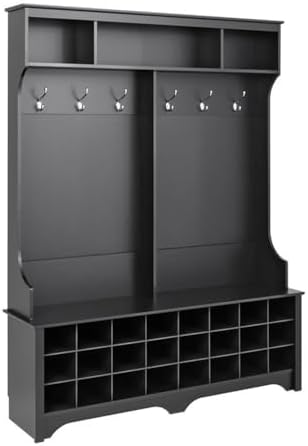
- Number of Shoe Cubbies — This measures the total count of individual compartments for footwear; 23 of the 69 listings we screened state this figure. A higher count allows for more pairs of shoes to be stored without overlapping.
- Cubby dimensions — This measures the internal width, height, and depth of each shoe compartment. You must ensure these dimensions are large enough for your specific boots or shoes to fit without the door sticking or the contents protruding.
- Bench weight capacity — This measures the maximum weight the seating surface can safely hold; 40 of the 69 listings we screened state this figure. A higher weight capacity is safer for multiple adults or heavy loads of gear.
- Heavy-duty hooks — These are hooks designed with thicker gauge metal or reinforced mounting points. They are necessary if you plan to hang heavy items like wet raincoats or heavy backpacks.
- Adhesive hooks — These are non-permanent hanging points that stick to the surface of the hall tree. They provide extra hanging space without requiring you to drill new holes into the wood or metal.
Where these choices show up in our reviews
Each of the 3 shown here has its own full review on this site; they run from $109.99 to $359.99.
If you prefer a contemporary look, see our guide to the best modern farmhouse hall tree.
Consider looking at our top-rated mudroom bench with coat hooks for a different storage layout.

Hall Tree Material and Construction Terms
- Engineered Wood — This is a manufactured product made from wood fibers and resins. It is a common material for hall trees, used in 27 of the 69 listings we screened.
- Wood — This refers to solid timber construction. It is used in 17 of the 69 listings we screened.
- Metal — This refers to a frame or body constructed from steel or aluminum. It is used in 15 of the 69 listings we screened.
- MDF — Medium-Density Fiberboard is a specific type of engineered wood. It is used in 6 of the 69 listings we screened.
- Bamboo — This is a sustainable grass used for construction. It appears in 1 of the 69 listings we screened.
- Integrated Bench — This means the seating area is a permanent part of the hall tree frame. It is the most common configuration, stated by 57 of the 69 listings we screened.
- Fixed Bench — This refers to a bench that is attached to the unit but may be structurally distinct from the main frame. It is stated by 10 of the 69 listings we screened.
- Removable Bench — This means the seating portion can be detached from the hall tree. This is a rare configuration, stated by only 1 of the 69 listings we screened.
Hall Tree Sizing and Layout Terms
- Width — This measures the horizontal distance across the front of the unit. 21 of the 69 listings we screened state a width, ranging from 11.8 to 60 inches.
- Height — This measures the vertical distance from the floor to the top. 26 of the 69 listings we screened state a height, ranging from 64.5 to 77 inches.
- Depth — This measures the distance from the front face to the back wall. 26 of the 69 listings we screened state a depth, ranging from 7.8 to 48.8 inches.
- Assembly Required — This indicates the unit arrives in pieces and must be put together. 50 of the 69 listings we screened state this status.
- Open Shelf — This refers to a storage area without a front door or cover. It is the most common door style, stated by 51 of the 69 listings we screened.
- Solid Door — This refers to a storage compartment with a full, opaque front. It is stated by 12 of the 69 listings we screened.
- Shaker — This describes a specific door style with a recessed center panel. It is stated by 1 of the 69 listings we screened.
- Barn door — This refers to a door that slides along a track. It is stated by 1 of the 69 listings we screened.
- Slatted Door — This refers to a door with horizontal or vertical gaps between wood pieces. It is stated by 1 of the 69 listings we screened.
- Fluted — This refers to a door with vertical grooves or ridges. It is stated by 1 of the 69 listings we screened.
- Swing — This refers to a door that opens on a hinge. It is stated by 1 of the 69 listings we screened.
Which hall tree measurements are often confused?
Buyers often confuse Width with Depth when planning for an entryway. Width is the side-to-side measurement that determines if the hall tree will fit between two walls, while Depth is the front-to-back measurement that determines if the unit will stick out too far into the walking path.
Newcomers to the category should explore the different types of hall trees available today.
Differences between integrated, fixed, and removable hall tree benches
Another common confusion occurs between Integrated Bench and Fixed Bench. An integrated bench is built into the main vertical structure of the hall tree, whereas a fixed bench might be a separate unit bolted to the frame. If you need to move the bench to clean underneath it, you should look for a Removable Bench, as most units are permanent.
Beginners can learn more by viewing how a hall tree works to manage your gear.
If a traditional unit won’t fit, see various hall tree alternatives for different entryway solutions.
Finally, Hook spacing and Number of Hooks are distinct requirements. A high number of hooks is useless if the spacing is too tight to accommodate a bulky coat. You should check the spacing to ensure your heaviest daily items have enough clearance to hang freely.
Make sure the piece fits your floor plan by viewing our guide to hall tree depth requirements.
To ensure it doesn’t block walkways, check out our advice on hall tree height.
How much weight can a hall tree bench hold?
The bench weight capacity determines the safety limit for sitting. While many shoppers assume a wooden bench can hold any amount of weight, the actual limit depends on the material and the internal bracing. Most of the listings we screened state a capacity between 20 and 440 lbs, with a median of 250 lbs. If you need to seat more than one person at a time, you should prioritize a unit with a weight capacity closer to the 440 lbs mark.
Proper spacing is key, so review our tips for choosing hall tree width before buying.
What do I need to know about cubby dimensions?
Cubby dimensions ensure shoes or boots fit without overlapping. If a cubby is too shallow, your boots will stick out into the hallway; if it is too narrow, you cannot fit wide winter boots. Because the number of shoe cubbies often varies from 2 to 24, you must verify the internal measurements of the cubby itself rather than just the total count of cubbies.
For a space-saving option, see our spec breakdown of the Prepac Narrow Hall Tree.
You can find a detailed analysis in our full review of the August Hall Tree.
What accessories do I need for a hall tree?
To maximize the utility of your hall tree, you may need to purchase additional items. Heavy-duty hooks are useful for hanging heavy bags, and adhesive hooks allow you to add hanging points to the side panels without drilling. If you want to keep your footwear in better shape, shoe trees can be placed inside the cubbies to maintain the shape of your shoes while they are stored.
For a different style of organization, look at our full Prepac Entryway Organizer review.
Browse our other hall tree pages
Hevan is reader-supported: some links on this page are affiliate links, and as an Amazon Associate Hevan earns from qualifying purchases at no extra cost to you. Learn more.