
Number of hooks for a hall tree should range from 6 to 12 count depending on the specific household size and storage requirements. A household with a family of five requires at least 5 to 8 count, while a busy household requiring heavy winter coat storage should look for 10 to 15 count.
If you need a high-capacity setup, see our comparison of the best hall tree for organized entryway.
Recommended Number of Hooks for Hall Trees by Use Case
| Use Case | Recommended Number of Hooks | Why this number |
|---|---|---|
| Hang a family of 5’s coats | 5 to 8 count | Calculated from a need for 1 to 2 hooks per person. |
| Hang a large collection of heavy winter coats | 10 to 12 count | Derived from a requirement for extra hanging points for bulkier items. |
| Hold a large family’s daily gear | 10 to 15 count | Based on a need for multiple hooks for bags, backpacks, and outerwear. |
| Hang a full set of scarves and bags | 6 to 9 count | Calculated from a need for 1 to 2 hooks for accessories and bags. |
| Hang coats in a farmhouse style | 6 to 10 count | Derived from a requirement for a dense, decorative display of outerwear. |
| Organize a busy household’s coats | 8 to 12 count | Calculated from a need for high-frequency access to multiple items. |
Where these choices show up in our reviews
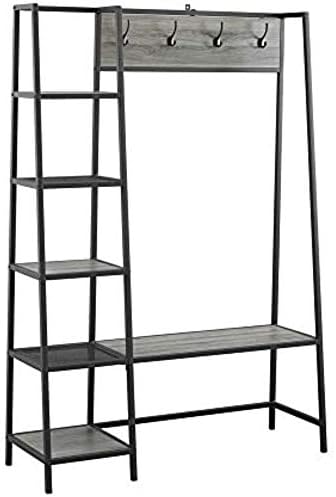
3 options shown here, $169.96 to $191.13, each with its own full review behind its name.
For a seating-focused solution, view our roundup of the best mudroom bench with coat hooks.
Compare different styles by viewing our guide to the best modern farmhouse hall tree.

What happens if you underbuy or overbuy hook count?
Underbuying the number of hooks on a hall tree leads to a crowded entryway where items overlap, causing coats to slip off or rub against each other. This creates a bottleneck where the first person to enter must move three other items just to reach their own jacket. If a buyer selects a unit with only 3 to 4 hooks for a family of four, they will likely end up with a disorganized pile of clothing on the floor or a bench.
For footwear storage options, see our comparison of the best hall tree with shoe cubbies.
Too many hooks create visual clutter and limit coat sleeve clearance
Overbuying the number of hooks creates a visual and physical clutter that can make a small hallway feel cramped. A hall tree with 16 hooks in a narrow space may result in hooks being placed so close together that wide coat sleeves cannot clear the neighboring hook. This reduces the practical utility of the extra hooks because they cannot accommodate the actual dimensions of the garments.
If you need a dedicated seat, look at our list of the best hall tree with storage bench.
Make sure to review the maximum weight capacity for hall trees before purchasing.
The common mistake with hook count and what to optimize instead
Many buyers select a hall tree based solely on the maximum number of hooks available in the listing. This often leads to a unit that looks impressive but lacks the necessary spacing to function for large winter coats. A buyer might choose a 12-hook model only to find that the hooks are clustered in a way that prevents them from hanging a bulky parka.
Understanding your budget is easy with our breakdown of what hall trees cost.
Prioritising hook spacing and unit depth over total hook count
Instead of optimizing for the highest hook count, buyers should optimize for the hook spacing and the depth of the unit. Proper spacing ensures that each hook has enough clearance for a sleeve to hang freely without catching on the next hook. If the hall tree is intended for heavy outerwear, the distance between the hook and the next adjacent hook is a more critical metric than the total count.
To ensure a perfect fit, study the recommended depth for hall trees.
You should also consider the ideal height for hall trees in your space.
How hook count interacts with other hall tree dimensions
The number of hooks on a hall tree is limited by the width and depth of the furniture. A high hook count is wasted if the width of the unit does not provide enough horizontal surface area to space the hooks apart. For example, a 30 cm wide unit cannot effectively support 12 hooks if those hooks are intended for full-sized coats.
Learn more about the different options in our overview of the types of hall trees.
Hall tree depth and 15 cm clearance requirements for functionality
Depth also dictates the utility of the hook count. If a hall tree has a shallow footprint, the hooks must be placed closer to the front edge to prevent the coats from hitting the wall. This positioning limits how many hooks can be placed in a row without them becoming unusable. A buyer must ensure the width of the hall tree accommodates the required number of hooks with at least 15 cm of clearance between each point to ensure functionality.
Newcomers can start by reading our explanation of what a hall tree is.
If a single unit is too large, explore the hall tree alternatives available.
Prioritising unit width over hook count in narrow hallways
When two requirements conflict, such as needing 12 hooks in a narrow hallway, the buyer must prioritize the width of the unit over the hook count. A hall tree with 8 well-spaced hooks will provide more usable storage than a 12-hook unit where the hooks are too crowded to use. Choosing a unit with insufficient width for the desired hook count results in a return or a piece of furniture that cannot be used as intended.
We provide a detailed analysis in our full review of the August Hall Tree.
Choosing a hall tree with a hook count that does not match the household size leads to a wasted investment in furniture that either lacks capacity or creates a cluttered environment. If a buyer selects a unit with only 5 hooks for a family of six, they lose the ability to keep the entryway organized, leading to daily friction as coats are left on chairs or doors.
You can find a spec breakdown in our full review of the Prepac Entryway Organizer.
Another compact option is featured in our review of the second Prepac Entryway Organizer.
Calculating required hall tree hooks based on user count and gear
A buyer first identifies the number of people who need to hang items daily. They then multiply that number by the type of items, such as adding extra hooks for bags or heavy winter gear. Finally, they check the width of the available hall trees to ensure the chosen hook count can be spaced out enough to allow for free movement of the sleeves.
See how it performs in our full review of the Walker Edison Entryway Bench.
More hall tree explainers and comparisons
Hevan is reader-supported: some links on this page are affiliate links, and as an Amazon Associate Hevan earns from qualifying purchases at no extra cost to you. Learn more.