
Weight capacity for a hall tree should typically fall between 200 lbs and 350 lbs for standard household use. You should select a unit that supports at least 250 lbs if you intend to store heavy winter coats or use the seating area for multiple adults simultaneously.
If you are working with limited floor space, explore the best narrow hall tree for small entryways.
To maximize your organization, see our comparison of the best hall tree for organized entryway.
How much weight capacity does a hall tree need?
The weight capacity of a hall tree determines the maximum load the frame and hooks can support without structural failure or tipping. For a single person living in an apartment, a 150 lb capacity often suffices for light accessories, but a 250 lb rating provides a safety buffer for heavier items. If you are choosing a hall tree for a busy family, prioritize a rating of 300 lbs or higher to ensure the bench remains stable under the weight of two people or a heavy pile of wet gear.
You might prefer a rustic look by viewing our guide to the best farmhouse hall tree with bench.
For a specific aesthetic, look at our ranking for the best modern farmhouse hall tree.
| Use Case | Recommended Weight Capacity | Why this number |
|---|---|---|
| Light Accessory Storage | 150 – 200 lbs | Supports hats, scarves, and lightweight bags without exceeding the limits of standard wood or metal frames. |
| Standard Household Use | 200 – 300 lbs | Provides a safe margin for 3 to 5 heavy winter coats and a single adult sitting on the bench. |
| High-Traffic Family Home | 300 – 400 lbs | Ensures the bench does not flex or sag when two people sit together or multiple heavy bags are hung. |
| Commercial or Mudroom Use | 400+ lbs | Necessary for heavy-duty industrial gear, large wet umbrellas, and frequent, high-impact use. |
Hall Trees we have reviewed in detail
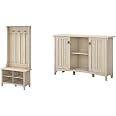
Each of the 3 shown here has its own full review on this site; they run from $149.99 to $191.13.
Consider a more compact option by viewing our comparison of the best mudroom bench with coat hooks.
If you need extra seating, view our comparison of the best hall tree with storage bench.


What happens if the weight capacity is too low?
If the weight capacity is too low, the hall tree may suffer from structural fatigue or immediate failure. A bench that cannot support the intended weight might develop a permanent bow in the seat or cause the legs to splay outward over time. This is similar to a chair with a weak frame; it might hold a person once, but it will eventually crack or lean under repeated use. Choosing a unit with insufficient capacity often results in the need to replace the item within months as the materials warp or the joints loosen.
Understanding your budget is easy when you see how much hall trees cost at every price level.
Proper spatial planning starts by learning how to choose the right depth for hall trees.
To ensure it fits your ceiling height, see our guide on choosing the right height for hall trees.
What happens if you overbuy the weight capacity?
Overbuying weight capacity usually results in a larger physical footprint or a more expensive construction material than necessary. A hall tree rated for 440 lbs may utilize heavy-gauge steel or solid hardwood, which increases the cost and the amount of floor space it occupies. If your needs only require 200 lbs, paying for a 400 lb rating does not provide a functional benefit, but it does mean you are paying for structural overhead that your household will never utilize. You lose money on unnecessary durability that does not improve the daily utility of the piece.
Make sure it fits your wall by viewing how to choose the right width for hall trees.
New buyers should start by reading the different types of hall trees explained.
What is the most common mistake with hall tree weight capacity?
The most common mistake is assuming that a high weight capacity for the bench automatically translates to high weight capacity for the hooks. While a bench might support 300 lbs of sitting weight, the individual hooks may only be rated for 10-15 lbs each. Buyers often overlook the hook limit and overload the top section, leading to bent hooks or pulled screws. You should optimize for the “hook-per-item” limit rather than just the total bench capacity. Calculate the weight of your heaviest coat and multiply by the number of coats you hang daily to ensure the hook hardware can support the concentrated load.
Learn the basics of how these pieces function by viewing our hall tree explained guide.
To understand technical specifications better, see our hall tree terms and specs guide.
How does weight capacity interact with other hall tree specs?
Weight capacity interacts with the depth and the base footprint of the hall tree to determine overall stability. A high weight capacity is wasted if the depth of the unit is too shallow to prevent tipping when a heavy load is placed on the top hooks. For a hall tree to safely support 300 lbs, the base must have a wide enough footprint to distribute that weight across the floor. If the depth is less than 12 inches, even a high weight capacity rating may be risky because the center of gravity shifts forward when heavy coats are hung. You must balance the rated capacity with a depth that provides a stable anchor for the weight you intend to hang.
You can find a detailed spec breakdown in our full review of the SOG-0013-1 Hall Tree.
For a deep dive into this specific slim model, see our full review of the Prepac Narrow Hall Tree.
The rest of our hall tree guides
Hevan is reader-supported: some links on this page are affiliate links, and as an Amazon Associate Hevan earns from qualifying purchases at no extra cost to you. Learn more.