
Bunk bed safety certifications are a mix of mandatory federal requirements, voluntary third-party safety standards, and decorative marketing labels. You need to verify that a bunk bed meets federal safety standards before purchase because these regulations dictate the minimum structural integrity for the frame. Check the weight capacity of the bunk bed against the weight of the heaviest intended occupant; if the occupant exceeds the rated limit, the structure risks permanent bowing or collapse.
What do ASTM standards mean for a bunk bed?
ASTM standards are voluntary guidelines established by the American Society for Testing and Materials that provide specific performance criteria for bunk bed construction. These standards, such as ASTM F1777, define the requirements for the structural integrity of the bunk bed, including the strength of the side rails and the stability of the frame. These standards guarantee that the bunk bed can withstand specific force loads and weight limits during testing. They do not, however, guarantee that a specific brand has been independently tested by a third party; they only provide the blueprint that a manufacturer must follow to claim compliance.
If you have limited floor space, see how to create a sleeping space for two kids in one room.
ASTM F1777 standards define bunk bed weight limits and dimensions
The ASTM F1777 standard focuses on the physical dimensions and load-bearing capabilities of the frame. It specifies how much weight the top bunk must support without excessive deflection. Because these are voluntary, a manufacturer can choose to follow them or not, but most reputable makers use them as a baseline for engineering. If a manufacturer claims to be ASTM compliant, they are stating that their design meets these engineering benchmarks.
Where these choices show up in our reviews
From $169.92 to $299.99: 3 of the 15 in this category we have reviewed in full.
Older children require sturdier frames, so consider comparing the best bunk beds for teens.
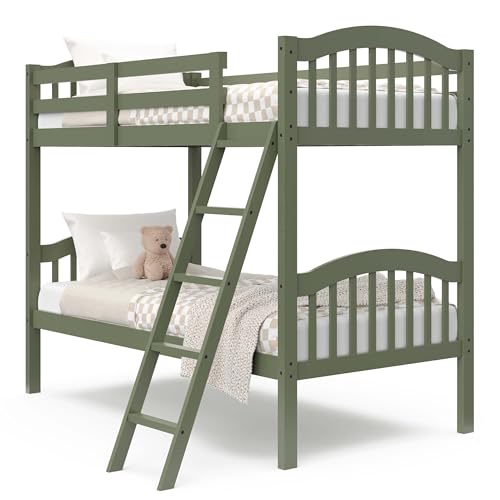


Which federal laws govern bunk bed safety?
Federal laws governing bunk bed safety are primarily enforced by the Consumer Product Safety Commission (CPSC) and mandate specific safety features for all bunk beds sold in the United States. These regulations require the bunk bed to have guardrails of a specific height and spacing to prevent falls. They also dictate the materials used to ensure they are non-toxic and meet flammability standards. These regulations do not guarantee that a bunk bed is “indestructible” or that it will prevent every possible accident; they only ensure a baseline of safety that is legally required for sale.
New buyers should first learn about the different types of bunk beds available today.
CPSC regulations set minimum guardrail heights for bunk bed safety
The CPSC regulations focus heavily on the “fall zone” and the structural connections of the frame. For example, the guardrails must be high enough to prevent a sleeping child from rolling off the side. If you are looking at a bunk bed, does the guardrail height match the requirements for the specific mattress thickness you plan to use? A failure to meet these requirements can lead to a product being pulled from the market, but the regulation itself is a minimum, not a maximum, of quality.
What does Greenguard Gold mean for a bunk bed?
Greenguard Gold certification is a chemical emissions standard issued by UL Solutions that verifies a product has low chemical-emitting vapors. This certification applies to the materials used in the bunk bed, such as the wood, metal finishes, and adhesives. It guarantees that the bunk bed will not release high levels of volatile organic compounds (VOCs) into the indoor air. It does not, however, guarantee the structural strength, weight capacity, or physical safety of the bunk bed frame.
Protection against manufacturing defects is easier to manage when you examine bunk bed warranties before purchasing.
Greenguard Gold certification limits chemicals in children’s bunk beds
This certification is particularly relevant for children’s furniture because kids spend significant time in their sleep environment. Greenguard Gold requires a more rigorous testing process than the standard Greenguard certification. It ensures that the materials used in the bunk bed meet strict limits for chemicals that can affect indoor air quality. While it is a high standard for chemical safety, it is entirely separate from the mechanical engineering required to keep a bunk bed stable.
If a vertical layout isn’t ideal, look into various bunk bed alternatives for your children.
Which safety failure modes do these standards address?
Safety failure modes in bunk beds primarily involve structural sway, guardrail gaps, and weight limit overloads. The ASTM and CPSC standards address structural sway by requiring specific lateral bracing and connection points between the vertical posts and the horizontal rails. These standards ensure the bunk bed does not wobble or tip when the top bunk is occupied or when a child moves on the surface.
Maximum allowable gaps between bunk bed rails prevent head entrapment
Guardrail gaps are addressed by regulations that specify the maximum allowable space between the slats or rails. These standards ensure that a child cannot slip through the gap. The gap must be small enough that a head cannot pass through, which is a critical safety requirement for bunk beds. If the gap is too wide, it creates a hazard that the standard is designed to prevent. A bunk bed that meets these standards will have a rail configuration that prevents this specific failure mode.
To ensure a proper fit, learn how to choose your bunk bed width correctly.
Manufacturer weight limits determine the maximum mass a bunk bed supports
Weight limit overload is a failure mode where the frame bows or collapses because it exceeds its rated capacity. The standards provide the framework for determining these limits, but the specific weight capacity of a bunk bed is determined by the manufacturer based on the materials used, such as solid wood versus powder-coated steel. If the frame is made of solid wood, it may have a different weight distribution than a steel frame. For example, a solid wood bunk bed might have a higher weight capacity but a larger physical footprint. Does the weight capacity of the bunk bed support your specific needs? The limit reflects the maximum total mass supported by the frame, not the weight of an individual mattress or occupant.
You can find a detailed breakdown of the frame’s specs in our full ikalido Loft Bunk Bed review.
How can you verify a bunk bed safety mark is real?
Verifying a bunk bed safety mark is real involves checking for physical documentation and specific identifiers on the product. Manufacturers often print “CPSC Compliant” or “ASTM Certified” on the packaging, but these are just claims until verified by the manufacturer’s documentation or a third-party certificate.
To verify these marks, you can perform the following checks:
This particular model is featured in our full Low Loft Bed review for those seeking a shorter profile.
- Request a Certificate of Compliance from the manufacturer to see the specific testing dates and lab results.
- Check for a UL (Underwriters Laboratories) file number or a similar third-party certification mark on the product’s components.
- Verify the Greenguard Gold certification by searching for the manufacturer’s name on the UL Solutions official registry.
- Inspect the physical guardrail spacing to ensure it meets the visual requirements of the standards, as this is a primary safety feature.
Which marks should you treat as non-negotiable?
CPSC compliance is a non-negotiable requirement for any bunk bed sold in the United States, as it is the legal baseline for safety. You should treat any mention of ASTM F1777 as a high-priority indicator of structural engineering quality. While Greenguard Gold is a voluntary certification, it is a significant factor for buyers who prioritize indoor air quality for children’s furniture.
Detailed performance data is available in our full Caribou Twin-Over-Twin review.
Prioritising specific weight capacities over vague safety labels ensures safety
When evaluating a bunk bed, you should prioritize the weight capacity and the guardrail height over decorative certifications. In contrast, a “safety-tested” label without a specific standard or weight limit provides no data. If a bunk bed does not clearly state its weight capacity or its compliance with recognized standards like ASTM, it is a risk to the buyer’s safety and the longevity of the furniture.
More bunk bed explainers and comparisons
Hevan is reader-supported: some links on this page are affiliate links, and as an Amazon Associate Hevan earns from qualifying purchases at no extra cost to you. Learn more.