Table length for an activity table refers to the linear measurement of the surface from one side to the other. The correct length depends on the number of children using the surface simultaneously and the specific type of craft or play activity planned.
Which table length suits my needs?
| If this is you | The Table Length that suits you | Why |
|---|---|---|
| A parent looking for a single-child craft station | 18 to 24 inches | This provides enough space for one child to spread out art supplies without the workspace feeling cramped. |
| A home user setting up a toddler’s play area | 24 to 30 inches | This standard size accommodates a toddler’s larger movements while remaining compact enough for small rooms. |
| A teacher seeking a collaborative station for two students | 30 to 36 inches | A 30-inch width is a common baseline for side-by-side work, while 36 inches allows for more elbow room. |
| A classroom needing a group work area for three or more children | 48 inches or more | Larger lengths allow multiple children to sit in a row or around a large surface without overlapping. |
| A user needing a large-scale construction or block zone | 48 to 72 inches | Extended lengths provide the continuous surface area required for building large structures or long train tracks. |
Products in this category with a full review here
Prices across these 3 run from $162.99 to $213.39; each one has a full review here.

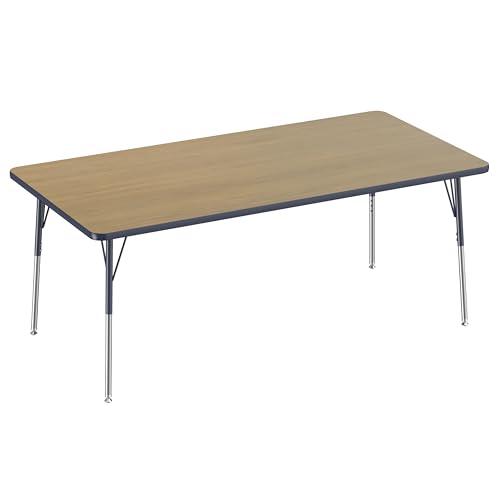
FDP Rectangle Classroom Table Pasadena Oak/Navy
If you are looking for a school setting, compare the best activity table for classroom use to see which model fits your space.
$213.39 price checked August 2026
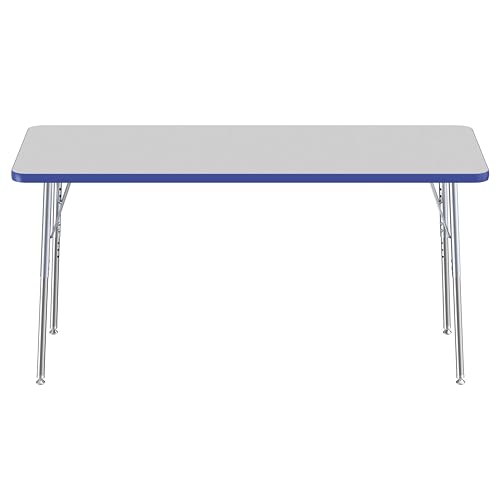
Factory Direct Partners FDP Rectangle Activity Table
$189.99 price checked August 2026
Read our full FDP Activity Table review
Understanding the surface area is important, but you should also view our guide on table height to ensure proper ergonomics.
How do I measure the correct table length before ordering?
To determine the correct table length, you must measure your available floor space and the intended “work zone” for the child.
Measuring your available floor space
Measure the length of the wall or area where the activity table will sit. Subtract at least 12 inches from the total wall length to ensure there is enough clearance for the chair to be pulled out and for the child to move around the table without hitting walls or furniture.
Defining the activity work zone
Identify the specific items the child will use, such as a large poster board or a set of building blocks. Measure the largest item you expect them to use and add 6 inches of clearance on both sides. This ensures the item fits comfortably on the surface without hanging over the edges.
Finding the length in product specifications
The table length is usually listed in the product specifications as “Length” or “Width,” often measured in inches. Look for the dimension that represents the longest side of the tabletop. Manufacturers typically list dimensions as Length x Width x Height; the first two numbers will tell you the footprint of the surface.
What happens if the table length is too small or too large?
Choosing a table length that does not match the intended use leads to specific functional issues during play or study.
Once you decide on a length, research the ideal table width to confirm the furniture fits your room dimensions.
The result of a table that is too short
A table that is too short for the intended activity causes “workspace crowding.” If a child is trying to paint or build, they may run out of room, leading to frustration or the need to constantly rearrange materials. In a multi-user setting, a short table forces children to sit too close together, which can lead to bumped elbows and interrupted focus.
The result of a table that is too long
A table that is too long for the space can create a “navigation hazard.” If the table extends too far into a room, it can block walking paths or make it difficult to move other furniture. For a single user, a table that is excessively long can also be overwhelming, as the child may struggle to reach the center of the surface or keep their materials organized across a large expanse.
What should I do if I fall between two table lengths?
If your requirements fall between two standard sizes, such as 30 inches and 36 inches, you should decide based on the “multi-user” factor.
Choosing for a single user
If only one child will use the table at a time, prioritize the smaller of the two options. A smaller table is easier to move, fits into more room configurations, and is often easier for a child to manage independently. You do not need the extra surface area if the primary goal is individual craft work.
Choosing for multiple users
If the goal is for two children to share the table, choose the larger of the two options. Providing the extra few inches of length ensures that each child has a dedicated zone, reducing friction and allowing them to work on separate projects simultaneously. In a classroom or shared home environment, the extra space is a preventative measure against overlapping work.
Choosing based on room limits
If your floor space is the primary constraint, choose the smaller size. It is better to have a functional, appropriately sized table that fits the room than a larger table that obstructs movement. You can always supplement a smaller table with a nearby storage unit or a secondary small surface for extra supplies.