There are four meaningfully different types of coffee bar cabinets defined by their structural footprint and how they manage weight. The primary dimension that separates these types is the clearance required for the machine’s operation and the material’s ability to support heavy commercial-grade espresso equipment without warping or buckling.
Freestanding Coffee Bar Cabinets
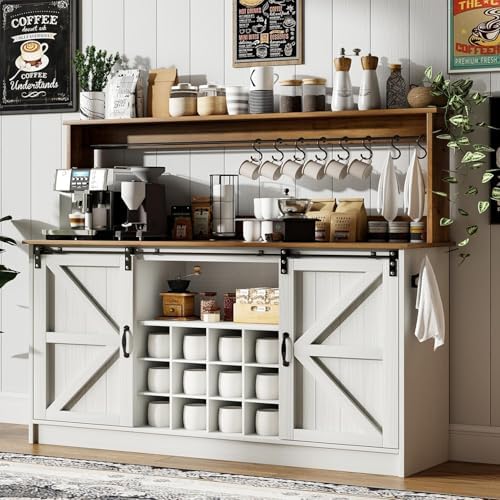
Freestanding coffee bar cabinets are self-supporting furniture pieces that sit independently on the floor. These units are for users who need a dedicated coffee station in a room without existing cabinetry, such as a dining area or a living room. They offer the best mobility and ease of placement because they do not require permanent installation. However, they give up the seamless look of built-in furniture and may have a larger footprint due to the need for structural legs. These typically sit in the mid-range price bracket.
Weight Capacity Requirements
Because these units are not anchored to a wall, the structural integrity of the base is the primary concern. A coffee bar cabinet must support the weight of a heavy espresso machine, which can exceed 40 lbs, plus the weight of a burr grinder and accessories. Look for designs with reinforced shelving or thick solid wood frames to prevent the cabinet from swaying or the shelves from bowing under constant load.
Where these choices show up in our reviews
Prices across these 3 run from $119.99 to $189.99; each one has a full review here.


Countertop Coffee Stations
Countertop coffee stations are smaller, compact units designed to sit on top of an existing kitchen counter or table. These are for users with limited floor space or those who want to organize their supplies in a smaller footprint. They excel at organizing pods, syrups, and small accessories in a tidy footprint. They give up the ability to house large, heavy espresso machines or bulky bottom-storage items. These are generally the most affordable option of the four types.
Size Limits
Countertop coffee stations are limited by the vertical and horizontal clearance of your existing surface. If your espresso machine requires significant head clearance for a portafilter, a countertop station may restrict your workflow. These are best suited for drip coffee setups, pour-over stations, or compact espresso machines that do not require heavy-duty heat management.
Base Coffee Cabinets
Base coffee cabinets are standard kitchen-style units designed to be installed at floor level, often under a countertop. They are for users who want to integrate their coffee station into the existing kitchen layout. They provide the best storage capacity for bulk beans and large supplies because they utilize the full height from the floor to the counter. They give up the ability to be moved easily, as they are often fixed in place. These sit in a mid-to-high price bracket depending on the material quality.
Material Quality
Because these cabinets often sit in high-humidity environments near sinks or steam, the material is a critical factor. Low-quality MDF or particle board can swell or crack over time. Choosing a cabinet with 18/10 stainless steel accents or solid wood components ensures the unit maintains its structural integrity in a kitchen environment.
Wall-Mounted Coffee Cabinets
Wall-mounted coffee cabinets are units fixed to the wall at eye level or slightly below. These are for users who need to clear floor space entirely or want a specialized “niche” for their coffee supplies. They excel at keeping items within easy reach and off the floor. They give up the ability to hold heavy, high-pressure espresso machines, as the wall anchors must support the weight. These are often the most expensive per-unit cost due to the specialized mounting hardware required.
Mounting Safety
Wall-mounted coffee cabinets are strictly for light storage of pods, mugs, and small accessories. To ensure safety, the weight of the items must stay well below the load rating of the wall studs. These are never suitable for heavy commercial-grade espresso stations which require a stable, floor-supported base to manage vibration and heat.
Comparison of Coffee Bar Cabinet Types
| Cabinet Type | Best-Fit Buyer | Main Advantage | Main Compromise |
|---|---|---|---|
| Freestanding | Users needing a mobile, standalone station | High mobility and easy placement | Larger footprint and visible legs |
| Countertop | Users with limited space or small setups | Compact organization of small items | Limited weight and height capacity |
| Base Cabinet | Users integrating into existing kitchens | Maximum storage and stability | Fixed location and installation required |
| Wall-Mounted | Users needing to clear floor space | Space-saving vertical storage | Strict weight limits for equipment |
How to Choose the Right Coffee Bar Cabinet
To determine which coffee bar cabinet type fits your needs, you should evaluate your space and equipment requirements against these three conditions.
Space and Mobility Check
If you need to move the station between rooms or if you do not have a permanent kitchen counter available, a freestanding coffee bar cabinet is the correct choice. If you have a permanent counter but need to organize the items on it, a countertop coffee station is the appropriate fit.
Equipment Weight Check
If you own a heavy, commercial-grade espresso machine that weighs over 30 lbs, you should prioritize a base cabinet or a heavy-duty freestanding cabinet. Wall-mounted options are not suitable for heavy machines. If your setup consists of a drip machine or a small capsule machine, any of the four types are viable.
Kitchen Integration Check
If you want the coffee station to look like a permanent part of your kitchen cabinetry, a base coffee cabinet is the best option. If you prefer a distinct, separate “zone” for coffee that stands out from the rest of the kitchen, a freestanding coffee bar cabinet creates a clear visual distinction.
Browse our other Coffee Bar pages
- Choosing the Best Coffee Bar Cabinet with Sliding Barn Doors
- The Coffee Bar Cabinets That Work Best with LED Lights
- Which Rattan Coffee Bar Cabinet Is Best?
- Best Coffee Bar Cabinets for Liquor and Glasses
- The Coffee Bar Cabinets That Work Best for Small Kitchens on a Budget
- Which Farmhouse Coffee Bar Cabinet with Hutch Is Best?