Material type refers to the primary substance used to construct the frame, doors, and shelving of a coffee bar cabinet. Your choice depends on your specific kitchen environment, the weight of your equipment, and your aesthetic requirements for durability versus style.
Which material type suits your coffee bar cabinet?
| If this is you | The Material Type that suits you | Why |
|---|---|---|
| You want a cabinet that matches high-end cabinetry or heavy furniture. | Solid Wood | Solid wood offers the highest structural integrity and can be finished to match existing luxury millwork. |
| You need a budget-friendly option that mimics the look of wood. | MDF or Particle Board | These engineered woods provide consistent surfaces and are more affordable than solid timber. |
| You prioritize a modern, industrial look with high moisture resistance. | Metal or Stainless Steel | Metal frames provide excellent weight distribution for heavy espresso machines and resist warping in humid areas. |
| You have a very small space and need a lightweight, easy-to-move unit. | Laminate or Veneer | These materials provide a durable surface over a stable core without the weight of solid timber. |
| You frequently clean your station with wet cloths or near a sink. | Marine-grade Plywood or Metal | These materials resist moisture penetration better than standard wood products in high-humidity zones. |
Where these choices show up in our reviews
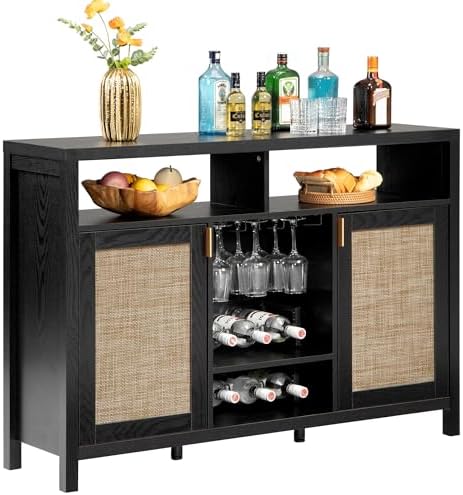
From $109.99 to $159.99: the 3 in this category we have reviewed in full.


How do I check the material quality before ordering?
To check the material quality before ordering, you must identify the specific wood species or engineered grade listed in the product specifications.
Look for the material description in the “Construction” or “Materials” section of the product details. If the listing mentions “Solid Wood,” it means the frame and doors are made from actual timber rather than a composite. If it specifies “MDF,” it indicates a medium-density fiberboard, which is an engineered wood product.
Identifying wood vs. engineered wood
The distinction between solid wood and engineered wood is often found in the depth of the material description. Solid wood will often name a species, such as Oak, Walnut, or Maple. Engineered wood like MDF or particle board will be listed by its manufacturing process. You can determine the suitability for a heavy espresso machine by checking if the shelving is reinforced with solid wood inserts or metal brackets, as these provide the necessary support for 30kg+ machines.
Verifying surface finishes and coatings
The surface finish is usually listed as a “Finish” or “Coating” spec, such as “Melamine,” “Laminate,” or “Powder-coated.” A powder-coated metal finish indicates a durable, industrial-grade surface that resists scratches. A melamine or laminate finish on a wood core provides a hard, wipeable surface that is easier to maintain than raw wood but less durable than solid timber.
What happens if I choose the wrong material?
Choosing a material type that is too weak for your specific coffee setup results in weight collapse or structural sagging. If the cabinet uses thin particle board without reinforced shelving, the weight of a commercial-grade espresso machine will cause the shelf to bow or the joints to pull apart over time.
The result of insufficient weight capacity
When a material cannot support the load, the cabinet may develop a permanent “smile” shape in the shelves. This happens because the internal fibers of low-density boards compress under constant pressure. For a coffee bar, this can lead to the machine becoming unstable or the cabinet tipping forward if the base is not heavy enough to counter the top-heavy load.
The result of poor moisture resistance
If you choose a material that is not moisture-resistant and place the cabinet in a high-humidity area, such as near a steam wand or a sink, the wood may experience material warping. This manifests as doors that no longer align with the frame, drawers that stick, or the cabinet base swelling and cracking. Engineered woods like MDF can swell significantly if they absorb water, making them unsuitable for areas with high steam output unless they are properly sealed.
What should I do if I’m between two material types?
If you are caught between two material types, you should choose based on the primary weight of your equipment versus your required maintenance level.
If the choice is between solid wood and high-quality MDF, and your primary concern is the weight of a heavy espresso machine, choose solid wood. Solid wood provides a higher weight-to-strength ratio and better structural longevity for heavy loads. If the choice is between solid wood and metal, and your primary concern is the environment (like a high-steam area), choose metal or a moisture-resistant hardwood.
Prioritizing weight capacity
For a coffee bar, the weight of the machine is the most critical factor. If you own a machine that exceeds 20kg, the material must have high structural integrity. In this case, the priority is the internal structure of the material rather than the surface finish. Choose the option that specifies reinforced shelving or solid wood components for the load-bearing areas.
Prioritizing maintenance and cleaning
If your coffee bar is in a high-traffic area where spills are frequent, prioritize a material with a hard, non-porous finish. A laminate or powder-coated metal surface is easier to wipe clean than a stained wood surface. If you fall between these two, look for a high-quality veneer or a treated wood finish that offers a balance of aesthetic appeal and easy maintenance.
More Coffee Bar explainers and comparisons
- Industrial Coffee Bar Cabinets Compared
- Choosing the Best Coffee Bar Cabinet with Sliding Barn Doors
- The Coffee Bar Cabinets That Work Best with LED Lights
- Which Rattan Coffee Bar Cabinet Is Best?
- Best Coffee Bar Cabinets for Liquor and Glasses
- The Coffee Bar Cabinets That Work Best for Small Kitchens on a Budget