When shopping for a coffee bar cabinet, most listings prioritize marketing adjectives like “luxury,” “modern,” or “elegant” over the structural specifications that determine if the unit will actually function. For a coffee station, the load-bearing capacity, material moisture resistance, and door swing clearance are the only load-bearing terms. You can ignore decorative descriptors; instead, focus on the physical dimensions and material grades that ensure the cabinet does not warp or collapse under the weight of heavy machinery.
Physical Dimensions and Material Specs for Coffee Bar Cabinets
Physical dimensions and material specs define the structural integrity and spatial footprint of a coffee bar cabinet.
- Weight Capacity – This is the maximum weight a shelf or surface can hold before it begins to sag or buckle; for espresso machines, you need a high weight capacity to prevent shelf failure.
- Material Grade (MDF vs. Solid Wood) – MDF is a composite material that is cost-effective but can swell in high-humidity environments, while solid wood offers higher durability and moisture resistance.
- Depth – This is the measurement from the front of the cabinet to the back wall; you need sufficient depth to ensure the machine’s footprint does not overhang the edge.
- Clearance – This refers to the empty space required in front of or around the cabinet for the door to swing open fully or for the user to operate the machine.
- Finish Type – This describes the surface coating, such as laminate, melamine, or lacquer, which determines how easily the surface can be wiped clean of coffee spills.
- Hardware Grade – This refers to the quality of hinges and handles; heavy-duty hardware is better for frequently opened doors or heavy cabinet doors.
Moisture Resistance and Surface Durability
Moisture resistance is a critical spec for any cabinet placed in a kitchen environment where steam and spills are common.
- Water-Resistant Coating – This is a chemical treatment or finish that prevents the wood core from absorbing liquid; a higher grade of moisture resistance is better for proximity to steam wands.
- Heat Resistance – This is the ability of the surface material to withstand high temperatures without melting or discoloring; look for materials rated for high-heat contact near the espresso group head.
Where these choices show up in our reviews
These 3 have their own full review on this site, and run from $119.99 to $164.98.

4ever2buy Farmhouse Coffee Bar Cabinet with Hutch
$164.98 price checked August 2026
If you prefer a rustic aesthetic, compare the top farmhouse coffee bar cabinet with hutch options available today.

4ever2buy Farmhouse Coffee Bar Cabinet with Hutch
$119.99 price checked August 2026
Read our full Farmhouse Coffee Bar review
You can also learn about different coffee bar cabinet types to see which layout fits your space.
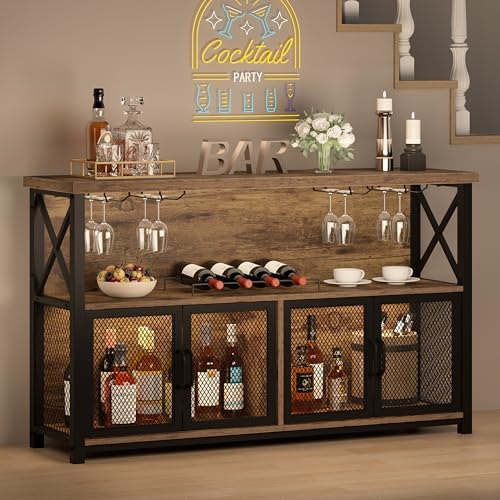
LVB Industrial Coffee Bar Farmhouse Wine Cabinet
$124.99 price checked August 2026
Read our full LVB Coffee Bar review
For a beginner’s guide, see how a coffee bar cabinet works for your home.
Storage and Layout Capabilities
Storage and layout capabilities determine how many supplies and accessories the coffee bar cabinet can organize efficiently.
- Adjustable Shelving – This allows you to change the height between shelves; adjustable options are better for accommodating different heights of syrup bottles and bean canisters.
- Internal Dimensions – These are the usable measurements inside the cabinet, which are often smaller than the external dimensions due to the thickness of the walls.
- Door Swing Radius – This is the arc of space a door occupies when opening; a smaller radius is better in tight kitchens to avoid hitting nearby appliances.
- Baseboard Clearance – This is the gap between the bottom of the cabinet and the floor; proper clearance ensures the cabinet sits flush against the wall without hitting the baseboard.
Commonly Confused Coffee Bar Cabinet Terms
Many buyers confuse similar-sounding terms that actually describe different physical properties of a coffee bar cabinet.
Depth vs. Clearance
Depth is the physical measurement of the cabinet’s footprint, while clearance is the empty space required around the cabinet to use it. You must measure both to ensure the cabinet fits in the room and that you have enough space to actually operate the espresso machine.
MDF vs. Particle Board
Both are engineered wood products, but MDF is denser and smoother than particle board. While both are cheaper than solid wood, MDF generally offers better stability for the weight of a heavy coffee station.
Weight Capacity vs. Load Rating
In the context of furniture, these terms are often used interchangeably to describe the maximum weight a surface can support. However, ensure the rating specifically refers to the shelf being used for the machine, as the top surface and internal shelves may have different limits.
Browse our other Coffee Bar pages
- The Coffee Bar Cabinets That Work Best for Small Kitchens on a Budget
- Which Farmhouse Coffee Bar Cabinet with Hutch Is Best?
- Best Coffee Bar Cabinets with Wine Racks
- Industrial Coffee Bar Cabinets Compared
- Choosing the Best Coffee Bar Cabinet with Sliding Barn Doors
- The Coffee Bar Cabinets That Work Best with LED Lights