Most households require an armoire closet with a weight capacity between 200 lbs and 500 lbs depending on the intended use. You should prioritize the weight capacity of the internal shelving and hanging rods over the external frame to ensure the unit remains stable under load.
Recommended Weight Capacity by Use Case
| Use Case | Recommended Weight Capacity | Why this number |
|---|---|---|
| Light Storage (Accessories/Linens) | 150 – 250 lbs | Focuses on low-density items like scarves, belts, and folded towels. |
| Standard Clothing (Mixed) | 300 – 450 lbs | Supports a mix of hanging garments and folded items in standard-depth bins. |
| Heavy Winter Wear & Coats | 500+ lbs | Accounts for heavy wool coats and leather jackets which exert high downward force. |
| Media and Equipment Storage | 400 – 600 lbs | Necessary for heavy electronics or dense storage bins packed to the ceiling. |
| High-Density Archive | 700+ lbs | Required for heavy-duty industrial-style storage or extremely dense filing. |
Armoire Closets we have reviewed in detail
These 3 have their own full review on this site, and run from $179.99 to $949.
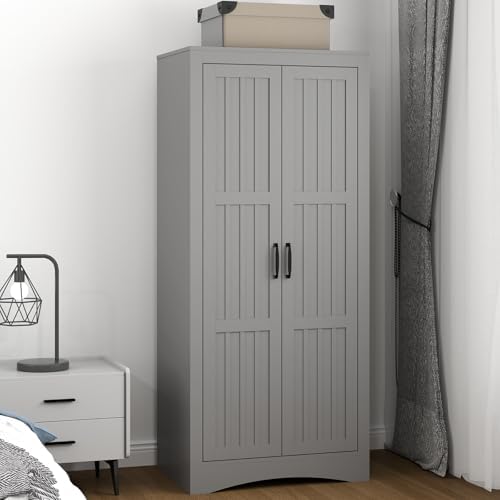
Wakefit 2 Door Wardrobe
$179.99 price checked August 2026
Read our full Wakefit 2 Door Wardrobe review
If you are on a budget, see the best wardrobe armoire with mirror under $1000 to find high-value options.

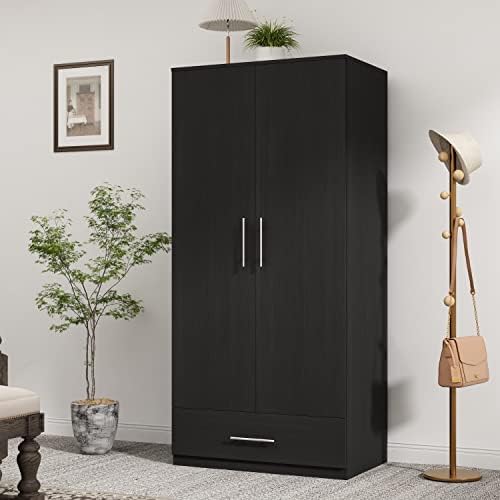
Hitow Wardrobe Armoire Closet with 2 Doors
$179.99 price checked August 2026
Measuring your space is vital, so learn how to choose the right height for armoires before buying.
What Happens if You Under-Provision or Over-Buy?
Under-provisioning occurs when the weight capacity of the armoire closet is lower than the actual load of your belongings. This often manifests as sagging shelves or bowing hanging rods.
The Risks of Under-Provisioning
If you place heavy items on shelves that are not rated for the weight, the material will begin to deflect. For many armoires, this leads to a permanent “smile” shape in the wood or metal. In extreme cases, the fasteners holding the shelf to the side panels may pull out, causing the shelf to collapse entirely. This is particularly common with MDF or particle board materials, which have lower structural integrity than solid wood or high-grade plywood.
The Cost of Over-Buying Weight Capacity
Over-buying refers to selecting an armoire with a weight capacity far beyond what you intend to store. While it sounds like a safety net, it often comes with a literal cost in physical space and price. High-capacity units require thicker, heavier structural members and reinforced joinery. These heavy-duty components take up internal volume that could otherwise be used for storage. If you only intend to store light accessories, paying for a 700 lb capacity frame means you are paying for heavy-duty hardware you will never utilize.
What is the Mistake Most Buyers Make with Weight Capacity?
The mistake most buyers make with weight capacity is focusing on the total weight of the furniture rather than the distributed weight per linear inch. A unit might be rated for 500 lbs, but that rating assumes the weight is spread evenly across the entire structure.
Proper spacing is just as important; view how to choose the correct width for armoires to ensure a perfect fit.
Distributed Weight Limits
You should optimize for the weight distribution of your specific items. For example, a heavy winter coat hanging on one side of a rod exerts much more stress than five shirts distributed across the same rod. Because weight is concentrated at the ends of the hanging rod, the “real” capacity of the hanging space is often lower than the “total” weight capacity of the armoire. When selecting a unit, check the weight limit per shelf and per rod specifically, rather than just the total weight the unit can hold.
Material Influence on Capacity
Buyers often overlook how the material of the armoire dictates the actual weight capacity. A solid wood armoire can often support significant weight due to the density of the fibers. Conversely, many affordable armoires use engineered wood. If you choose an engineered wood unit, you must be more conservative with your weight distribution. You should optimize for the material’s limits by using shelf dividers or smaller bins to prevent any single point of the shelf from bearing too much weight at once.
How Weight Capacity Interacts with Other Deciding Specs
Weight capacity interacts with the armoire closet’s depth and door swing clearance because these factors determine how much weight you can actually fit inside. A high weight capacity is wasted if the interior dimensions prevent you from placing the items that require that capacity.
Depth and Volume Constraints
The depth of the armoire determines the volume of the storage space. If you need a high weight capacity for heavy storage bins, you need a unit with a depth of at least 20 inches. A shallower unit may have a high weight rating, but it will not accommodate the large, deep bins required for heavy storage. You must ensure the depth allows for the specific containers you plan to use to reach your storage goals.
Door Swing and Access
Door swing clearance determines how you interact with the weight inside. If you have an armoire with a high weight capacity but the doors cannot open 90 degrees due to floor space, you will struggle to move heavy items in and out. For heavy items, you need clear access. If the door swing is restricted, you may find that even if the armoire can hold the weight, the practical use of that weight becomes difficult because you cannot reach the items at the back of the unit.
The rest of our Armoire guides
- Best Wardrobe Armoires for Bedroom Storage
- Freestanding Armoire Closets for Small Spaces Compared
- Choosing the Best White Wardrobe Armoire for a Guest Room
- The 3 Door Wardrobe Armoires That Work Best for Home Storage
- Which Wardrobe Armoire with Lock is Best for Security?
- Best Solid Wood Wardrobe Armoires