
Length for a futon couch is the measurement from end to end along the longest side of the frame. The specific length you need depends on the number of people who will sleep on the surface and the available floor space in your room.
If you are on a strict budget, browse the best budget daybed couch for studio living.
Which Futon Couch Length Suits Your Space?
| If this is you | The Length that suits you | Why |
|---|---|---|
| A single sleeper for a studio apartment or guest room | 60 in to 72 in | These dimensions provide a standard single-person sleeping surface that fits in tight spaces. |
| A primary guest bed for two people in a standard room | 72 in to 84 in | This range allows for a double-width sleeping area, providing enough room for two adults to lie side-by-side. |
| A large family room with significant floor space | 84 in to 96 in | These larger dimensions offer a queen-sized feel, though they require a substantial footprint in the living area. |
| A multi-person lounge or large sectional conversion | 96 in and above | Extra-long models provide maximum surface area for multiple sleepers but may exceed the limits of standard doorways. |
Futon Couches covered by our own reviews
Prices across these 3 run from $192.99 to $1589.95; each one has a full review here.
Parents can find a durable option in our best futon couch for kids playroom.


How to Measure Your Space for a Futon Couch
Measuring your available space requires a clear understanding of the total footprint a futon couch occupies when fully extended. You must measure the floor area where the couch will sit while in its upright position, and then measure the clearance required when the bed is pulled out. Use a metal tape measure to record the distance from one wall to the opposite wall where the couch will reside. Many manufacturers list the length in the product specifications as the horizontal dimension of the couch in its folded state.
You can maximize your floor plan by finding the best sofa bed for small apartments.
To accommodate visitors comfortably, compare the best sleeper sofa for guest rooms.
Measuring doorway clearance and floor space for futon couch delivery
You should also measure the width of your room to ensure the couch can be moved into place. Does your doorway have enough clearance for a 96 in frame? A frame that is 96 in long may be difficult to navigate through a standard 32 in wide door if the armrests are wide. Measure the doorway’s width and height, then compare those numbers to the largest dimension of the futon couch. If the couch is 84 in long, you should ensure you have at least 85 in of unobstructed floor space in front of the seating area to allow for the conversion mechanism to fully deploy.
People with limited square footage should view the best sofa bed for tiny homes.
Interpreting length and width specifications in futon couch listings
Check the listing data for the “Length” or “Width” spec, as these terms are often used interchangeably by different manufacturers to describe the long side of the unit. Note that if a listing provides a “Width” of 72 in, this usually refers to the length of the couch when it is folded. Verify this by looking for a secondary dimension, such as “Depth,” which describes how far the couch sticks out from the wall. If only one dimension is provided, assume it is the longest side of the couch in its primary sitting position.
Make sure your choice is comfortable by considering the proper height for futon couches.
For optimal sitting posture, evaluate the correct seat height for futon couches.
What Happens if the Futon Couch Length is Wrong?
Choosing a length that is too short results in a sleeping surface that feels cramped for more than one person. If you select a 72 in couch for a two-person guest room, the sleepers will have very little room to move or adjust during the night. This lack of space often leads to people sleeping in a staggered position rather than side-by-side. The physical limit of the frame dictates the boundary of the sleeping surface; a 72 in frame cannot provide more than 72 in of usable space.
Ensure your piece fits your layout by checking the standard width for futon couches.
How a long futon couch affects room flow and accessibility
A length that is too long creates different practical issues, primarily regarding room flow and accessibility. A 96 in couch might dominate a small room, leaving no space for walkways or other furniture. It can also make the room feel smaller because the visual weight of a large piece of furniture occupies the majority of the floor. If the couch is too long for the room, you may find yourself unable to walk past it comfortably when it is in its folded position. This mistake often forces the buyer to place the couch in a corner, which may limit the functionality of the conversion mechanism.
If a futon isn’t right, explore various futon couch alternatives.
Clarify the technical details in our futon couch terms and specs, explained.
Avoiding delivery failures by checking narrow entry point dimensions
In some cases, a length that is too long creates a logistical failure during the delivery and setup phase. If the couch exceeds the dimensions of your hallway or front door, it may be impossible to get the unit into the room without professional disassembly. This is a permanent constraint of the physical dimensions. A couch that is 100 in long simply will not fit through a 90 in opening. Always confirm the “Length” spec against your home’s narrowest entry point before finalizing a choice.
Protect your investment by reviewing the futon couch warranties we check.
What to Do if You Fall Between Two Futon Couch Lengths?
Deciding between two different lengths often comes down to the priority of the sleeping surface versus the living area footprint. If you are choosing between a 72 in and an 84 in futon couch, consider the primary use of the room. If the room is used mostly as a living space and only occasionally for sleeping, the smaller 72 in length preserves more floor space for daily movement. If the room serves primarily as a guest bedroom, the 84 in length provides a more comfortable experience for those staying overnight.
New buyers should start with our futon couch explained guide.
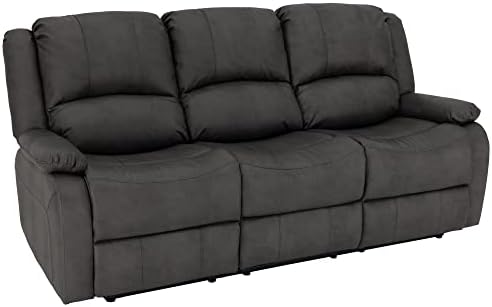
View our detailed analysis of the full RecPro Charles Triple Recliner review.
Maintaining clearance between a futon couch and nearby furniture
The decision becomes a matter of clearance. Measure the exact distance from the wall to the nearest obstacle, such as a coffee table or a television stand. If your available space is 85 in, an 84 in couch will fit, but it will leave only 1 in of clearance. This can make the room feel crowded. If you have 80 in of space, you must choose the 72 in model. The 72 in model is the safer choice for a room with limited dimensions. It ensures that the couch does not feel like it is pressing against other furniture.
See our data-driven breakdown in the full Charles Double Recliner review.
Choosing the smaller futon couch length for tight room layouts
When requirements conflict, such as needing a large sleeping surface but having a small room, you may need to reconsider the layout. Some buyers choose a 72 in couch and accept a smaller sleeping area to maintain a functional living space. Others choose the larger size and remove other furniture from the room to accommodate the length. If you are exactly between two sizes, choose the smaller length. It is easier to make a room feel larger by adding smaller decor than it is to make a small room feel bigger by removing a large couch. The smaller length provides a safer margin for error in a space that is already tight.
Get the facts in our full PP-ZF001YE Ottoman Bed review.
Browse our other futon pages
Hevan is reader-supported: some links on this page are affiliate links, and as an Amazon Associate Hevan earns from qualifying purchases at no extra cost to you. Learn more.