When researching folding screen room dividers, distinguishing between structural specifications and marketing descriptors is essential for finding a durable unit. Load-bearing terms involve the physical construction, such as frame material and hinge mechanics, which dictate whether a screen will sag or tip over. Marketing vocabulary often focuses on aesthetic styles or vague “privacy” claims that do not describe the actual build. You should prioritize the technical data regarding weight capacity, material thickness, and hinge types to ensure the divider functions as a stable piece of furniture rather than a flimsy prop.
Physical Construction and Material Specs
- Freestanding – This describes a divider that stands on its own base without requiring a wall mount or floor anchors. A wider base provides better stability for taller panels.
- Wall-Mounted – This refers to a folding screen designed to be fixed to a vertical surface. These units do not require floor clearance and are used for permanent architectural separation.
- Wood Frame – This indicates the internal structure is made of timber. Wood frames offer a higher weight-to-stability ratio and are often preferred for heavy-duty use.
- Metal Frame – This denotes a structure made of steel or aluminum. Metal frames allow for thinner profiles and are often used in more modern, minimalist designs.
- Panel Thickness – This is the measurement of the material (e.g., 15mm or 30mm) from front to back. A higher number generally indicates a more rigid panel that is less likely to warp.
- Weight Capacity – This is the maximum amount of weight a divider can support or withstand. Higher weight ratings are necessary if you plan to hang decorations or heavy fabrics from the panels.
- Friction Binding – This refers to the resistance felt when moving the panels. High-quality machining ensures low friction binding, meaning the panels glide smoothly without sticking or catching.
- Panel Sagging – This is a failure mode where the middle of a panel bows downward. Selecting a frame with reinforced horizontal supports reduces the risk of sagging over time.
- Tip-over Hazard – This is a safety metric regarding the center of gravity. A lower center of gravity and a wider base footprint reduce the risk of the unit falling when pushed.
Where these choices show up in our reviews
These 3 have their own full review on this site, and run from $116.99 to $149.99.

Sorbus 8-Panel Black Room Divider
$149.99 price checked August 2026
Read our full Sorbus Room Divider review
If you need a larger layout, see the best 6 panel room divider options.

6-Panel Rustic Brown Barn Door Room Divider
$119.99 price checked August 2026
Read our full Barn Door Room Divider review
You can also learn about the various types of folding room dividers available today.
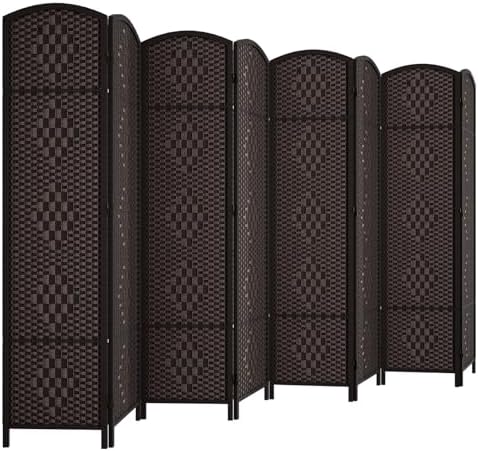
Rose Home Fashion 6 ft Tall Room Divider
$116.99 price checked August 2026
Read our full Rose Home Room Divider review
New users should first view how a folding room divider works for basic functionality.
Folding Mechanics and Movement
- Accordion Fold – This is a design where panels fold in alternating directions like an accordion. This style allows for the most compact storage when the divider is not in use.
- Bi-fold – This refers to a design where two panels are joined to fold in one direction. These are typically smaller and used for narrower spaces or smaller privacy needs.
- Hinge Type – This identifies the mechanical joint connecting the panels. Heavy-duty steel hinges are superior to plastic hinges for preventing the panels from separating under weight.
- Degrees of Rotation – This is the range of motion allowed by the hinges. Most folding screens offer 180-degree rotation, which allows the panels to lay flat against each other.
- Pivot Point – This is the specific axis around which the panels turn. A well-placed pivot point ensures that the weight of the outer panels does not strain the inner joints.
Material Standards and Finishes
- Solid Wood – This indicates the panels are made from a single piece of timber. Solid wood is the high-end benchmark for durability compared to engineered wood products.
- MDF (Medium-Density Fibreboard) – This is an engineered wood product made from wood fibers and resin. MDF is often more stable than solid wood in high-humidity environments but can be heavier.
- Laminate Finish – This is a thin decorative layer bonded to the surface. Laminate is easier to clean and more resistant to scratches than raw wood finishes.
- Textured Surface – This describes a physical pattern pressed into the material. Textured surfaces can hide fingerprints and minor scuffs better than smooth, high-gloss finishes.
- Weight per Panel – This is the individual weight of a single section. Knowing this helps you determine if the unit is heavy enough to remain stable or light enough to move easily.
Commonly Confused Terms
Buyers often confuse Freestanding with Portable. While most freestanding screens are portable, not all portable screens are freestanding; some portable options are designed strictly for wall-mounting or hanging. You should check the base design to ensure the unit does not require a wall to stay upright.
Wood Frame and Solid Wood are also frequently confused. A wood frame means the internal skeleton is timber, but the exterior panels could still be made of plastic, fabric, or MDF. Solid wood means the entire panel is made of timber. If you require maximum durability, look for solid wood; if you want a lighter weight, a wood frame with composite panels may be sufficient.
Accordion Fold and Bi-fold are often used interchangeably in marketing, but they represent different configurations. An accordion fold uses three or more panels to create a zig-zag, while a bi-fold uses only two. You need an accordion fold if you require a wider area of coverage or a more compact storage footprint.
Browse our other Folding Screen pages
- Choosing the Best Folding Screen Room Divider for Home Office
- The Folding Screens That Work Best for Bedroom Privacy
- Which 6 ft Tall Room Divider Is Best for Privacy?
- Best Wood Frame Room Dividers for Your Home
- 4 Panel Room Dividers for Privacy Compared
- Choosing the Best 6 Panel Room Divider for Your Space