Width for folding room dividers refers to the total horizontal measurement of the unit when fully unfolded. The correct width depends on the specific area you intend to partition and the level of visual obstruction you require.
Which Width Suits Your Space?
| If this is you | The Width that suits you | Why |
|---|---|---|
| You need to block a doorway or create a small nook in a studio apartment. | 30 in. to 48 in. | Smaller widths allow for easier maneuverability in tight corridors while still providing a localized visual barrier. |
| You want to separate a home office from a living area in a standard room. | 60 in. to 72 in. | These widths provide enough coverage to create a distinct “room” feel without requiring a permanent wall. |
| You are partitioning a large open-plan studio or a commercial gallery space. | 84 in. to 96 in. | Larger spans offer the necessary coverage to hide a significant amount of floor space or equipment. |
| You need a full-height privacy screen for a changing area or dressing room. | 72 in. or greater | A wider footprint ensures that the screen does not gap at the edges when viewed from an angle. |
Folding Screen Room Dividers covered by our own reviews
Prices across these 3 run from $104.99 to $122.99; each one has a full review here.
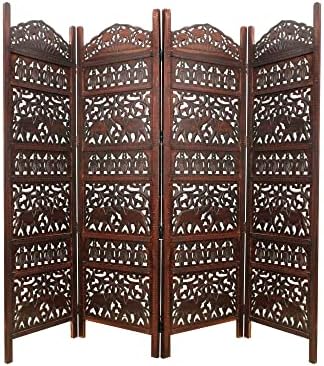
Elephant Hathi Walnut Brown 4 Panel Wood Screen
$122.99 price checked August 2026
Read our full Elephant Hathi Screen review
If you prefer a classic look, see our roundup of the best wood frame room divider options to find your style.

4 Panel Wood Frame Folding Room Divider
$104.99 price checked August 2026
Read our full 4 Panel Wood Frame Folding Room Divider review

U-MAX 6 Panel Weave Fiber Room Divider
$119.99 price checked August 2026
For more specific privacy solutions, view our comparison of the best 4 panel room divider models.
How Do I Measure for a Folding Screen Room Divider?
To establish your required width, you must measure the linear distance of the floor space you want to cover. Use a metal tape measure to record the distance from one side of the partition point to the other.
Measuring Technique
Measure the floor, not the wall. Because folding screens have a physical thickness and a slight “swing” when they are not perfectly flush against a surface, a measurement that is exactly equal to your wall width may result in a screen that is difficult to position. Add 1 inch to your total desired width to account for the thickness of the panels and the hinges.
Finding the Width on a Product
The width of a folding screen room divider is usually listed in the product description as the “total unfolded width” or “expanded width.” If the listing only provides the width of a single panel, multiply that number by the number of panels in the set to find the total coverage.
What Happens if the Width is Wrong?
Choosing a width that is too narrow results in a “gap” effect where the screen fails to provide the intended privacy or visual separation. If the screen is 48 in. wide but you are trying to cover a 60 in. opening, the remaining 12 inches of exposed space often make the divider look like an incomplete furniture piece rather than a functional partition.
Once you have the width set, learn how to choose the correct height for folding room dividers.
Issues with Narrow Widths
A narrow width also fails to provide adequate side-to-side coverage. If you are using the screen to hide a mess or a workspace, a narrow unit may only block the view from one specific angle, leaving the area visible from any other position in the room.
Issues with Wide Widths
Choosing a width that is too wide creates a physical obstruction in the room. A screen that is 96 in. wide may be difficult to move through a hallway or may strike furniture when you attempt to fold it into storage. If the screen is wider than the actual area you want to partition, it may lean outward or become unstable because it lacks the support of a wall on both sides.
What Should I Do if I Fall Between Two Widths?
If your space measurement falls between two standard manufacturing sizes, you should prioritize the larger width. A folding screen room divider that is slightly too wide can be angled or overlapped to fit a space, but a screen that is too narrow cannot be extended to cover more ground.
The Overlapping Strategy
When you choose a wider screen for a slightly smaller space, you can overlap the panels slightly at the point where the screen meets a wall. This creates a more secure visual barrier and prevents light or sightlines from leaking through the edges. This technique is often used in professional interior design to ensure a “solid” look for a room divider.
Stability and Clearance
When selecting the larger width in a borderline case, ensure you have enough clearance to fully fold the unit. Measure the path the screen takes as it collapses; if the width is so large that the folded unit cannot fit through your doorway or into its storage spot, you must reconsider the smaller size or find a multi-panel configuration that can be separated.
Where to go next in our Folding Screen coverage
- Choosing the Best Folding Screen Room Divider for Home Office
- The Folding Screens That Work Best for Bedroom Privacy
- Which 6 ft Tall Room Divider Is Best for Privacy?
- Best Wood Frame Room Dividers for Your Home
- 4 Panel Room Dividers for Privacy Compared
- Choosing the Best 6 Panel Room Divider for Your Space