You need a shelf weight capacity between 50 lbs and 150 lbs depending on your specific equipment and storage needs. A coffee bar cabinet must support the concentrated weight of heavy machinery while maintaining structural integrity over years of use.
Recommended Shelf Weight Capacity by Use Case
| Use Case | Recommended Shelf Weight Capacity | Why this number |
|---|---|---|
| Light Beverage Station | 50 – 75 lbs | Supports standard mugs, small pour-over drippers, and light dry goods like tea tins. |
| Standard Home Espresso | 75 – 100 lbs | Accommodates a standard home espresso machine (30-50 lbs) plus accessories and a full hopper. |
| Prosumer / Heavy Gear | 100 – 150 lbs | Supports heavy-duty dual boiler machines or large-format grinders that exert significant downward pressure. |
| Bulk Storage & Supplies | 150+ lbs | Necessary for large 5lb+ bags of coffee beans, bulk syrup containers, and heavy inventory. |
Products in this category with a full review here
From $135.99 to $259.99: the 3 in this category we have reviewed in full.


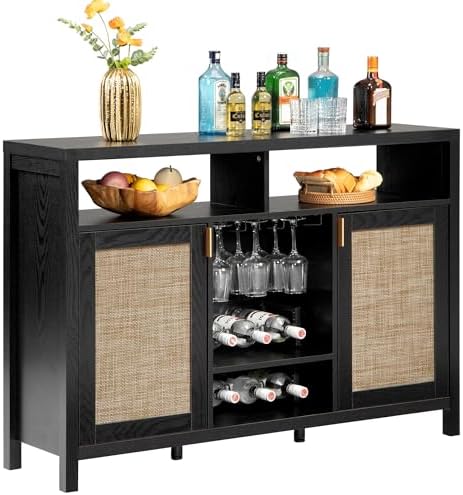
SICOTAS Rattan Coffee Bar Sideboard Buffet Cabinet
$135.99 price checked August 2026
Read our full SICOTAS Rattan Cabinet review
To ensure your workspace fits perfectly, see our guide on choosing external width for these storage units.
What Happens if You Under-Provision or Over-Buy Shelf Capacity?
Risks of Under-Provisioning
Under-provisioning occurs when the rated capacity of a shelf is lower than the concentrated weight of your coffee equipment. If a shelf is rated for 50 lbs but holds a 40 lb espresso machine and a 15 lb grinder, the load exceeds the limit.
Structural failure in coffee bar cabinets often manifests as “shelf sag,” where the center of the board bows downward. Over time, this bowing creates an uneven surface that can cause liquids to pool or heavy machinery to shift. In severe cases, the fasteners may pull out of the side panels, leading to a sudden collapse of the shelf and potential damage to your equipment or flooring.
The Cost of Over-Buying Capacity
Over-buying capacity refers to selecting a cabinet with industrial-grade weight limits that far exceed your actual needs. While it sounds like a safe choice, high-weight-capacity shelves often require thicker materials and heavier-duty mounting hardware.
This extra durability translates to increased weight and bulk for the cabinet itself. A cabinet designed to hold 300 lbs may have much thicker side walls and heavier doors than a 100 lb capacity unit, making it harder to move or fit into a specific kitchen nook. You may also pay a premium for reinforced joinery that provides no functional benefit to your specific setup, effectively paying for structural overhead you will never utilize.
What Mistake Do Most Buyers Make with Shelf Weight Capacity?
Most buyers make the mistake of looking at the total weight capacity of the cabinet rather than the concentrated weight of the heaviest single item. A cabinet might be rated to hold 200 lbs total, but if the shelf holding the espresso machine is only rated for 75 lbs, the unit will fail even if the total weight is well under the limit.
Optimizing for Concentrated Load
You should optimize for the “footprint” of your heaviest machine. A 40 lb espresso machine concentrates that entire weight onto a 10×10 inch area. This creates much higher stress on the shelf material than 40 lbs of coffee beans spread across the entire surface.
To ensure reliability, verify that the specific shelf where the machine sits can handle the weight of that machine alone, plus a 20% buffer for accessories. If a shelf is made of MDF or thin particle board, it may have a high “total” capacity but a low “concentrated” capacity, making it unsuitable for heavy espresso gear.
How Shelf Weight Capacity Interacts with Other Deciding Specs
Shelf weight capacity is often limited by the material type and the depth of the cabinet rather than just the thickness of the shelf itself. If you choose a cabinet with a high weight rating but a shallow depth, you may find it impossible to fit the very machines that require that high capacity.
Material Types and Weight Limits
The material of the shelf determines how weight is distributed. Solid wood and high-quality plywood offer superior weight distribution and are less prone to sagging than MDF or particle board.
If your requirements involve a heavy prosumer machine, choosing a cabinet with 18/10 stainless steel shelving or solid hardwood is a more reliable path than a cabinet with a high-rated particle board shelf. Wood and metal can handle the “point load” of a heavy base more effectively than composite materials, which can crumble or crack under concentrated pressure.
Depth and Stability Constraints
A high shelf weight capacity is wasted if the cabinet depth is insufficient for the equipment. Many high-capacity coffee machines require at least 18 to 20 inches of depth to allow for clearance of the drip tray and steam wand.
If you select a cabinet that can hold 150 lbs but only offers 12 inches of depth, you will be unable to place your heavy machine inside. In this scenario, the weight capacity is a moot point because the physical dimensions of the machine prevent it from being used in the cabinet. Always ensure the depth accommodates the machine’s footprint before prioritizing the weight rating.
Every Coffee Bar guide in this category
- Choosing the Best Coffee Bar Cabinet with Sliding Barn Doors
- The Coffee Bar Cabinets That Work Best with LED Lights
- Which Rattan Coffee Bar Cabinet Is Best?
- Best Coffee Bar Cabinets for Liquor and Glasses
- The Coffee Bar Cabinets That Work Best for Small Kitchens on a Budget
- Which Farmhouse Coffee Bar Cabinet with Hutch Is Best?