Door swing clearance is the amount of floor space required in front of an armoire closet to allow the doors to open fully to a 90-degree angle. Your specific clearance needs depend on the physical dimensions of your room and how much floor space you are willing to sacrifice for access to your belongings.
Which Door Swing Clearance suits my space?
| If this is you | The Door Swing Clearance that suits you | Why |
|---|---|---|
| You are placing the armoire in a narrow hallway or a high-traffic corridor. | 12 in. to 18 in. | Narrower clearance allows for passage while the door is open, though it may limit the door’s maximum swing angle. |
| You want to use the armoire as a primary wardrobe in a standard bedroom. | 24 in. to 30 in. | This range provides a comfortable arc for the doors to swing wide enough to reach items stored in the back of the unit. |
| You have a large, open dressing room or a spacious walk-in area. | 36 in. or more | Maximum clearance allows for wide-swinging doors that can be left open without obstructing any nearby furniture or walkways. |
| You are installing the armoire in a corner where one side is against a wall. | 18 in. to 24 in. | Since one side of the door is restricted by the wall, the clearance is only required for the arc of the outward-swinging door. |
| You prefer to keep the doors open constantly during use. | 36 in. or more | A larger clearance ensures that the doors do not protrude into the walking path when left in a fully open position. |
Reviewed examples from this category
These 3 have their own full review on this site, and run from $179.99 to $949.

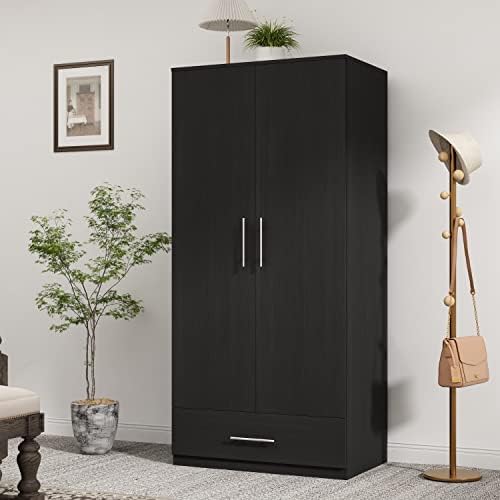
Hitow Wardrobe Armoire Closet with 2 Doors
You can also find the best wardrobe armoire with mirror under $1000 to fit your specific budget.
$179.99 price checked August 2026

Palace Imports 100 Solid Wood Smart Wardrobe
$749 price checked August 2026
Read our full Smart Wardrobe review
Ensure your space is adequate by learning how to measure proper armoire depth before you buy.
How do I measure the required Door Swing Clearance?
Door swing clearance is measured by identifying the radius of the door’s arc plus the thickness of the door itself. You must determine this by measuring the distance from the hinge point to the outer edge of the door’s face.
Calculating the arc radius
To find the required clearance, measure the width of the armoire door from the hinge side to the handle side. Add the thickness of the door to this measurement to determine the total radius of the swing. This number represents the minimum distance required from the hinge to the nearest obstacle in front of the unit.
Locating the clearance on the armoire specs
Manufacturers typically list the door swing clearance in the technical specifications under “clearance requirements” or “operation dimensions.” If the measurement is not listed, you can derive it by taking the door width and adding the door thickness. Some units may specify a “minimum clearance” which refers to the space needed for the door to open to 90 degrees rather than 180 degrees.
Mapping the floor space
Use a piece of painter’s tape or a chalk line to mark the arc on your floor. Start at the hinge point and swing the tape out to the calculated radius. This visualizes the “dead zone” where the door will occupy space, ensuring that no chairs, beds, or other furniture sit within that arc.
What happens if the Door Swing Clearance is too small or too large?
The consequences of incorrect Door Swing Clearance involve either a loss of functionality or a waste of usable floor space.
It is also important to understand how to choose the correct armoire height for your ceiling.
Risks of insufficient clearance
If the Door Swing Clearance is too small, the door will hit a wall, piece of furniture, or another object before it reaches a 90-degree angle. This prevents you from accessing items stored in the center of the armoire. In some cases, you may be forced to open the door only a few inches, making it impossible to remove hanging garments or reach deep shelves.
Risks of excessive clearance requirements
If you choose an armoire that requires a Door Swing Clearance larger than your space allows, you may find the unit creates a permanent obstruction. A large swing radius can “cut off” a walkway, making it difficult to move through a room. If the door requires 30 in. of clearance but you only have 24 in., the door will strike nearby objects every time it is opened, potentially damaging the door’s finish or the hinges.
What should I do if my space falls between two Door Swing Clearance values?
When your available floor space sits between two standard Door Swing Clearance values, you must decide whether to prioritize accessibility or floor space. If you are forced to choose between a slightly smaller clearance and a larger one, consider the frequency of use for that specific armoire.
Prioritizing internal access
If the armoire is your primary wardrobe, you should lean toward the larger clearance. It is better to have an extra 2 inches of clearance to ensure you can reach every garment than to have a door that stops short and leaves the back of the unit inaccessible. If the space is tight, consider if the armoire can be placed in a location where the door swings into a less-used area of the room.
Prioritizing room flow
If the armoire is for occasional storage, such as seasonal items, you can opt for the smaller clearance. A door that only opens to 75 or 80 degrees instead of a full 90 degrees is often sufficient for occasional use. In these cases, the priority is keeping the walkway clear for daily movement, and the slight reduction in door swing is a trade-off for better room flow.
Alternative door configurations
If you cannot meet the required Door Swing Clearance for a standard swinging door, consider the door style of the armoire. Some armoires feature narrower doors or “bi-fold” styles that require significantly less clearance than a single large swinging door. If the measurement is borderline, a bi-fold door can often provide the same internal access with half the required floor space.
More Armoire explainers and comparisons
- Best Solid Wood Wardrobe Armoires
- Wardrobe Armoires with Mirrors Under $1000 Compared
- Choosing the Best Wardrobe Armoire with Drawers for Home Storage
- Best Wardrobe Armoires for Bedroom Storage
- Freestanding Armoire Closets for Small Spaces Compared
- Choosing the Best White Wardrobe Armoire for a Guest Room