Wall-Mounted Vanity Mirror Terms and Specs, Explained in Plain English
When shopping for wall-mounted vanity mirrors, many listings use marketing language like “crystal clear” or “shimmering finish” that provides no measurable value. To make an informed decision, you should ignore these subjective descriptors and focus on load-bearing specifications: the glass thickness, the Color Rendering Index (CRI), the Color Temperature (Kelvin), and the IP rating for moisture protection. These technical values determine how the mirror performs in a high-humidity bathroom environment and how accurately it reflects your appearance for tasks like makeup application or grooming.
Where these choices show up in our reviews
These 3 have their own full review on this site, and run from $116.99 to $399.99.


Understanding Vanity Mirror Lighting Standards
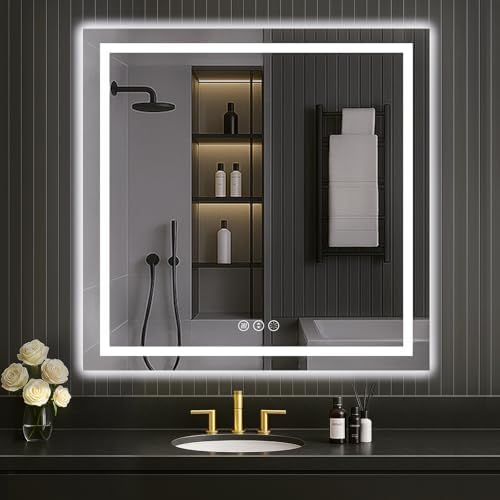
Lighting specifications determine the quality of the reflection and the safety of the electrical components in a bathroom environment.
- Color Temperature (Kelvin) – This measures the warmth or coolness of the light, usually ranging from 3000K to 6000K. A lower number like 3000K produces a warm, yellowish glow, while 5000K-6000K produces a “daylight” white that is better for seeing true colors.
- CRI (Color Rendering Index) – This number measures how accurately a light source reveals the true colors of objects, rated on a scale of 0 to 100. A CRI of 90 or higher is the standard for vanity mirrors to ensure makeup colors and skin tones do not look washed out or distorted.
- IP Rating (Ingress Protection) – This standard measures how well the mirror‘s electrical components are sealed against moisture and dust. For a bathroom, look for an IP44 rating or higher to ensure the unit is safe for use in areas where steam or splashes occur.
- Lumens – This measures the total amount of visible light emitted by the mirror. A higher lumen count provides a brighter mirror, but you must balance this against the size of the mirror to avoid an overwhelming glare.
- Dimmable – This indicates the mirror has a built-in controller to adjust brightness levels. Dimmable mirrors allow you to switch between a bright “task” light for grooming and a softer “ambient” light for general bathroom use.
- Front-Lit vs. Back-Lit – Front-lit mirrors have LEDs on the front surface to shine directly on your face, while back-lit mirrors shine light toward the wall. Front-lit options are generally better for vanity tasks as they eliminate shadows on the face.
Physical Construction and Glass Specs
The physical construction of the mirror determines its durability, the clarity of the reflection, and how much weight the glass can support.
- Glass Thickness – This is the depth of the mirror pane, often measured in millimeters (mm). Thicker glass, such as 5mm or 6mm, is more durable and less prone to “funhouse” distortion than thinner 3mm panes.
- High-Definition Silvering – This refers to the quality of the reflective coating applied to the back of the glass. High-definition silvering ensures a sharp reflection without the “ghosting” or “rainbow” edges found on cheaper mirrors.
- Integrated Demister Pad – This is a heating element built into the mirror to prevent steam from fogging the glass. A mirror with a demister pad is essential for bathrooms without high-powered ventilation to keep the surface clear after a shower.
- Beveled Edge – This is a slanted cut along the perimeter of the mirror glass. A beveled edge can help hide the raw edge of the glass and provide a more finished look, but it does not affect the reflection quality.
- Structural Bracing – This refers to internal supports within the frame or mirror assembly. For mirrors larger than 60 inches, internal bracing is necessary to prevent structural sag, where the mirror bows or cracks under its own weight over time.
- Frame Material – This identifies what the border is made of, such as aluminum, wood, or stainless steel. Stainless steel (often 18/10 grade) is a preferred choice for bathrooms because it resists corrosion better than standard metals.
Mounting and Installation Requirements
Compatibility and mounting terms ensure the mirror fits your specific wall space and can be safely supported by your home’s structure.
- Weight Capacity – This is the maximum weight the mounting hardware can support. You must ensure your wall studs can support the combined weight of the mirror and its mounting bracket.
- Clearance Depth – This is the amount of space the mirror requires to sit off the wall. You need to measure your wall depth to ensure the mirror does not protrude too far into the walkway or hit a door.
- Hardwired vs. Plug-in – Hardwired mirrors require a permanent electrical connection to your home’s wiring, while plug-in mirrors use a standard power cord. Hardwired options provide a cleaner look without visible wires hanging from the ceiling.
- Mounting Bracket Type – This describes how the mirror attaches to the wall, such as a French cleat or a standard rail. A French cleat provides a more secure, level hold for heavy mirrors compared to simple hanging hooks.
Commonly Confused Mirror Terms
Buyers often confuse several terms that sound similar but offer different functional benefits.
Color Temperature vs. Brightness
Color temperature (Kelvin) refers to the hue of the light—whether it looks yellow or blue. Brightness (Lumens) refers to the intensity of the light—how much light is actually being produced. You can have a very bright mirror that has a warm (low Kelvin) color.
Demister Pad vs. Anti-Fog Coating
A demister pad is an active heating element that uses electricity to clear steam. An anti-fog coating is a chemical treatment applied to the glass surface. A demister pad is more effective in high-humidity environments, while coatings can wear off over time.
Beveled Edge vs. Polished Edge
A beveled edge is a physical angle cut into the glass to create a 3D border effect. A polished edge is simply the flat side of the glass that has been smoothed down to remove sharp corners. Polished edges are standard, while beveled edges are a stylistic choice.
Browse our other Vanity Mirror pages
- Choosing the Best LED Bathroom Mirrors with Anti-Fog
- The Wall Mounted Vanity Mirrors That Work Best for Large Spaces
- Which Round Wall Vanity Mirrors Are Best Under $150?
- Best Lighted Bathroom Mirrors with RGB Backlighting
- Space Saving Wall Mounted Vanity Mirrors for Small Bathrooms Compared
- Choosing the Best Dimmable Bathroom Mirrors with Memory Function