For most backyard sofas, you should look for a cushion thickness between 4 in. and 6 in. to balance comfort with structural integrity. If you prioritize a deep-seated lounge experience, aim for the higher end of that range, while 4 in. provides a firmer, more upright seating position.
Recommended Cushion Thickness for Backyard Sofas by Use Case
| Use Case | Recommended Cushion Thickness | Why this number |
|---|---|---|
| Standard Patio Dining | 4 in. to 5 in. | Provides sufficient support for upright seating without causing the cushion to bottom out during meals. |
| Deep Lounge Seating | 5 in. to 7 in. | Allows for a “sink-in” feel that mimics indoor furniture and accommodates larger body weights comfortably. |
| Outdoor Sectionals | 6 in. to 8 in. | Thicker cushions are necessary to maintain a level surface when multiple people sit together on a long bench. |
| Low-Profile Daybeds | 3 in. to 4 in. | Keeps the profile low to the ground while providing a dense enough layer to prevent feeling the frame. |
| High-Traffic Commercial | 4 in. | Thinner cushions are easier to replace and less prone to heavy sagging in high-use public environments. |
Products in this category with a full review here
3 reviewed options, $139.99 to $329.99, with the full write-up behind each name.

FDW 4 Piece Wicker Conversation Set
$139.99 price checked August 2026
Read our full FDW Wicker Set review
If your primary goal is a wet area, explore the best outdoor sofa for pool side use.
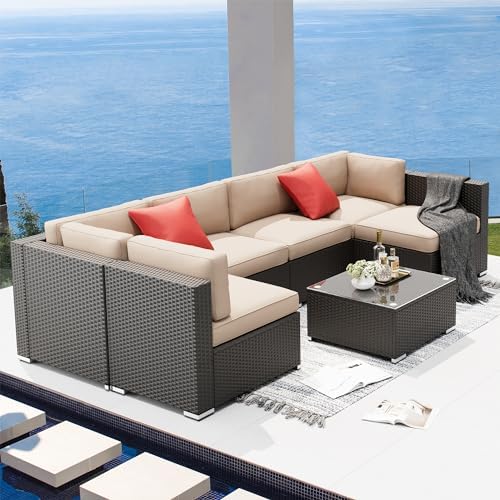

M&W 3 Pieces Patio Sofa Set
Many homeowners prefer a modular layout, so view our guide to the best outdoor sectional sofa for backyard use.
$176.22 price checked August 2026
What Happens if You Under-Buy or Over-Buy Cushion Thickness?
Risks of Under-Provisioning
If you choose a cushion thickness below 3 in. for a standard backyard sofa, you risk “bottoming out.” This occurs when the foam or fiber fill compresses completely under your weight, causing your body to make direct contact with the hard frame of the sofa. Because outdoor furniture often uses metal or wooden frames to withstand weather, this can make the seating experience uncomfortable or even painful after only a few minutes. Additionally, very thin cushions lack the loft needed to distribute weight evenly, leading to pressure points on the hips and lower back.
The Real Cost of Over-Buying
Choosing a cushion thickness that exceeds 8 in. introduces several practical drawbacks. First, oversized cushions are significantly heavier, making them difficult to move, rotate, or store during the off-season. Second, extremely thick cushions can cause “structural sag.” If the internal foam is too thick for the frame’s gauge, the weight of the cushion itself can cause the sofa frame to bow or warp over time. Finally, over-buying thickness often leads to a “mushy” feel where the cushion loses its shape quickly because the internal support structure cannot maintain the height of the foam.
To ensure your new piece fits in the space, learn how to choose your total footprint length carefully.
The Mistake Most Buyers Make with Cushion Thickness
Many buyers make the mistake of assuming that a thicker cushion automatically equals a more comfortable sofa. In reality, the primary factor for comfort is foam density and “loft,” not just the total thickness in inches. A 2 in. cushion made of high-density, high-resiliency (HR) foam can often feel more supportive and durable than a 6 in. cushion filled with low-quality polyester fiberfill.
Optimizing for Density and Fill Type
Instead of focusing solely on the thickness measurement, you should optimize for the material’s ability to retain its shape. For backyard sofas, look for high-density polyurethane foam. This material provides the necessary “push-back” to keep the cushion thick over years of use. If you prefer a softer feel, ensure the thickness you choose is paired with a high-fill weight, which prevents the cushion from flattening into a pancake after the first month of use.
How Cushion Thickness Interacts with Other Deciding Specs
Cushion thickness does not exist in a vacuum; it is limited by the frame’s depth and the seat height of the backyard sofa. If you select a very thick cushion, you must ensure the sofa frame has enough “seat depth” to accommodate it. A 7 in. cushion on a shallow 20 in. deep seat will result in the front edge of the cushion hanging over the side, which is a tripping hazard and leads to premature wear on the fabric.
The Seat Height Constraint
The total seat height is the sum of the frame height and the cushion thickness. If you choose a 6 in. cushion, the frame must be low enough that the final height remains comfortable for your height. If the frame is already tall, a thick cushion may make the seat too high, causing you to feel unstable. Always measure your desired final seat height—usually between 17 in. and 19 in. for standard seating—and subtract your desired cushion thickness to find the correct frame height.
Weight Capacity and Support
Cushion thickness is also tied to the weight capacity of the backyard sofa. Heavier users require a thicker cushion to distribute weight across a larger surface area. However, this requires a frame built with commercial-grade aluminum or heavy-duty treated wood. A thin cushion on a lightweight frame will fail much faster under heavy loads, regardless of the foam quality. Ensure the frame’s structural gauge matches the thickness and weight requirements of your intended use.
The other Backyard Sofa guides we have published
- Pool Side Outdoor Sofas Compared
- Choosing the Best Wicker Rattan Conversation Set for Your Backyard
- Best Outdoor Sectional Sofas for Your Backyard
- Durable Wicker Patio Furniture Sets Compared
- Choosing the Best Patio Sofa for a Small Balcony under $300
- The Backyard Sofa Sets That Work Best with a Glass Table