Internal depth refers to the measurement of the usable space between the front and back interior walls of a curio cabinet. The specific depth you require depends entirely on the maximum dimensions of the items you intend to display.
Which Internal Depth Suits Your Collection?
| If this is you | The Internal Depth that suits you | Why |
|---|---|---|
| You are displaying small items like jewelry, coins, or small porcelain figurines. | 8 in. to 10 in. | These items require very little clearance and benefit from a shallower cabinet that sits closer to walls. |
| You want to display standard glassware, small vases, or average-sized ceramic plates. | 11 in. to 13 in. | Most standard household glassware and medium-sized ceramics require this depth to sit comfortably without touching the glass. |
| You collect larger items like oversized vases, large sculptures, or deep decorative bowls. | 14 in. to 16 in. | Larger decorative pieces often have a significant footprint that requires extra clearance to avoid protruding past the door frame. |
| You are displaying large-scale collectibles, oversized books, or deep storage containers. | 17 in. and above | Extra-deep units are necessary for items that exceed standard dimensions, ensuring they remain fully enclosed within the cabinet. |
Where these choices show up in our reviews
These 3 have their own full review on this site, and run from $119.99 to $131.99.
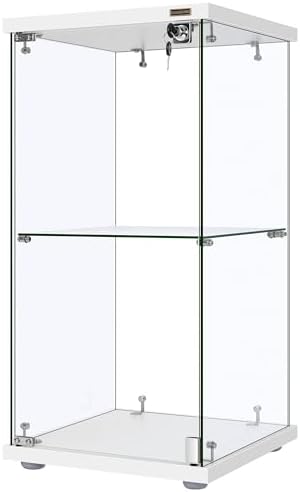
VIVOHOME 2 Layer Glass Display Cabinet
$119.99 price checked August 2026
Read our full VIVOHOME Glass Cabinet review
If you are looking for a centerpiece, browse our top picks for living room curio cabinets.
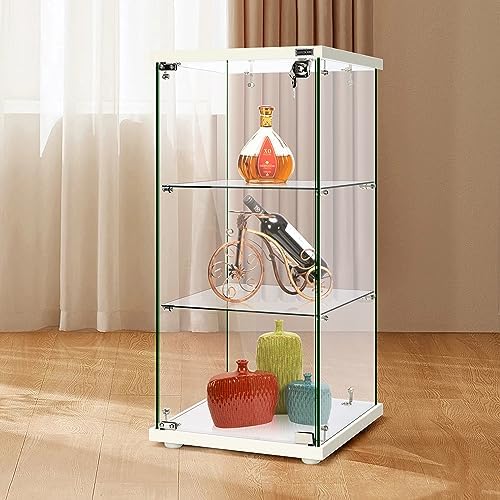

FANYUSHOW Tempered Glass 4-Shelf Curio Cabinet
$131.99 price checked August 2026
Make sure you have enough clearance by learning how to measure external curio cabinet height.
How do I measure the internal depth I need?
To establish your required internal depth, you must measure your largest and most frequently displayed items. Measure the depth of the object from its front-most point to its back-most point, ensuring you include any handles or protrusions.
The measurement process
Place your largest item on a flat surface and measure its depth in inches. Add 1 inch of “buffer” space to this measurement. This extra inch ensures that the item does not press against the glass or the back panel, which can cause scratches or prevent doors from closing smoothly.
Where to find the depth on a curio cabinet
Manufacturers typically list the internal depth in the product specifications, often distinguished from the “external depth.” Because the frame and glass panels take up space, a cabinet with an external depth of 18 in. might only have an internal depth of 16 in. Always look for the “internal” or “usable” dimension to ensure your items will fit.
What happens if the internal depth is the wrong size?
Choosing an internal depth that is too shallow results in items protruding past the front of the cabinet or preventing the doors from closing. When an object sits too close to the front, it is at higher risk of being bumped or knocked over, and it may obstruct the view of items placed deeper in the unit.
Before purchasing, verify your space by checking the door swing clearance for curio cabinets.
The problem with under-sized depth
If your items are deeper than the cabinet’s interior, they will stick out past the door frame. This creates a safety hazard and can lead to the glass doors hitting the objects every time they are opened or closed, potentially cracking the glass or chipping the items.
The problem with over-sized depth
Selecting a cabinet that is significantly deeper than your collection requires than necessary results in wasted space and a larger physical footprint in your room. If you only need 10 in. of depth but purchase a 16 in. unit, the back half of the cabinet will remain empty, making the unit appear sparse and inefficiently sized for your needs.
What do I do if my item size falls between two depth options?
If your measurement falls between two standard internal depths, you should always choose the larger of the two options. It is easier to arrange smaller items in a deeper cabinet than it is to force larger items into a shallow one.
Prioritizing clearance
Choosing the larger depth provides a safety margin for the door swing. Curio cabinets often use hinges that require a small amount of clearance for the door to sit flush against the frame. If an item is exactly the same depth as the cabinet, the door may not be able to close completely because the object is pressing against the door’s path.
Checking return policies for sizing
Because internal depth is a physical constraint that cannot be altered after purchase, verify the return policy before ordering. If you are unsure whether your items will fit, look for a retailer that offers a clear return window or a size-exchange policy to mitigate the risk of receiving a cabinet that is too small.